the roastery playbook
starting a roastery - the real playbook
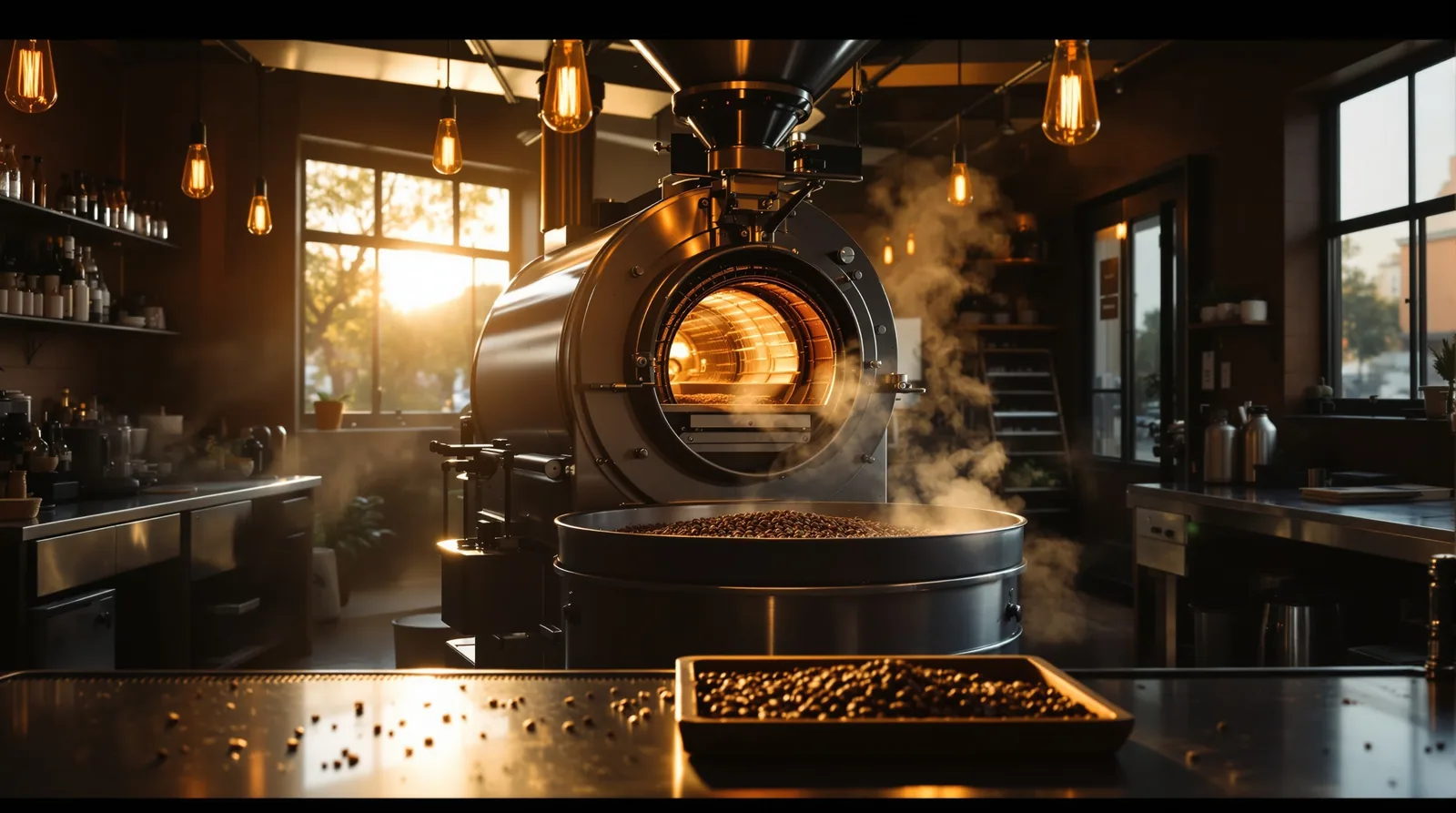
you smell first crack and you know. the popcorn pop of green beans hitting drum temperature, the wave of warm caramel from the cooling tray, the green sample on a cupping table waiting for your verdict. you want this for a living. between you and there sits a roaster machine you haven't bought, a green coffee supplier you haven't met, and the question of whether you roast for yourself or for fifty cafes. this is where we answer them.
last updated · ~14 min read by gautam khorana, editor
section one
the first decision: dtc, wholesale, or both
before you spec a machine or call an importer, you answer one question: who buys your roast. three answers shape every decision downstream.
direct-to-consumer (dtc) means you sell bags to drinkers through your shopify store, a subscription, and your cafe counter. margins are highest at 65-72% gross. customer acquisition cost in 2026 is brutal - meta ads at $25-40 per first-order acquisition for specialty coffee. you need a brand, a story, and content. the math works when retention is good and your average order value crosses $35.
wholesale means you sell 5-25kg bags to cafes, hotels, and offices. margins are tighter at 40-55% gross. but volume comes in chunks of 20-200kg/month per account and your customer acquisition costs almost nothing once your name is on three good bars in your city. our wholesale directorycovers the roasters who've made this work.
both is what most roasters end up doing within two years. the wholesale book pays the rent. the dtc store builds the brand. start with one - usually whichever your founder background suits - and add the other once the first is profitable.
section two
choosing your roaster machine
your roaster machine is the biggest capital decision you'll make and the longest-lead-time order you'll place. lead times in 2026 are 16-32 weeks new from the factory, depending on brand and configuration. used machines on coffeed.com or roastersexchange clear in days but require service knowledge and a workshop you can move 200-600kg of cast iron into.
| brand / model | drum size | price new (USD) | notes |
|---|---|---|---|
| probat probatone 5 | 5kg | $45-60k | german engineering, gold standard for small specialty |
| diedrich IR-5 | 5kg | $35-45k | infrared, cleanest cup, made in idaho |
| giesen W6A | 6kg | $35-45k | dutch, fast adoption with young roasters |
| loring s7 nighthawk | 7kg | $120-145k | convection-only, 80% lower gas use, environmental flagship |
| probat probatino p12 | 12kg | $65-85k | step up for wholesale-focused roasters |
| diedrich IR-12 | 12kg | $60-75k | larger ir, popular with us regional roasters |
| probat p25 | 25kg | $110-140k | commercial-grade wholesale workhorse |
| loring s15 falcon | 15kg | $170-200k | large-scale loring, used by top-tier wholesalers |
the rule we've heard from every founder we've walked: buy one size bigger than you think you need. you outgrow a 5kg drum within 18 months if wholesale takes off. selling and replacing a roaster is expensive and disruptive. going from 5kg to 12kg means you can roast a 1kg sample batch on the same machine, which solves your r&d problem too.
a 5kg drum can produce 80-100kg of finished beans in an 8-hour shift assuming a 14-minute roast cycle and weight loss in the 17-19% range. a 12kg drum produces 200-250kg in the same shift. a 25kg drum produces 400-500kg. your decision should match the wholesale volume you have line-of-sight to in year two, not year one.
section three
sourcing your green coffee
you have four sourcing paths. you can buy from a green importer who stocks already-arrived coffee in a warehouse near you. you can buy origin lots that ship from the producer country directly. you can partner on direct trade with a producer you've visited. or you can bid on cup of excellence and best of panama auction lots for your hero-tier coffees.
the first roastery year, you start with importers. nordic approach (oslo, ships globally), cafe imports (minneapolis), caravela (north carolina + colombia), mercanta (london), melbourne coffee merchants (australia), indo café imports (jakarta). minimum order is usually one bag (60-70kg). you order 4-8 samples at a time, cup them blind, pick what you want, and commit to a 3-6 bag lot.
green coffee pricing in 2026 lands at $4-8/lb for solid specialty, $8-15/lb for top-of-the-curve micro-lots, and $20-100+/lb for cup of excellence / geisha / champion-tier lots. add 30-40% for shipping, duty, and warehousing to land it. add another 17-19% for roast weight loss. your retail bag at £14-20 for 250g or $18-25 for 12oz needs to clear all of this and your operating costs.
direct trade - flying to a farm in colombia or ethiopia, building a multi-year relationship, paying above the c-market - usually starts in year three or four, when your wholesale book justifies a 5-15 tonne annual commitment to one or two producers. it's what builds the brand stories that move bags.
section four
profile development and cupping
a roast profile is the time + temperature + airflow curve from charge to drop. the same bean roasted on the same machine at two different profiles tastes like two different coffees. roast profile is where roasters earn their reputation.
you log every roast. cropster, artisan, or roastime are the three software options most roasteries use to log curves. you sample-roast in small batches before committing to a production batch. you cup every roast on a regular schedule - at least once a week for production batches, every batch for new lots - using SCA cupping protocol (8.25g coffee, 150ml water, 4-minute steep, three lid breaks, slurps, score, notes).
the SCA cupping form gives you a 100-point quality score. anything 80+ is specialty grade. 85+ is exceptional. 88+ is rare. you score honestly on flavour, aftertaste, acidity, body, balance, sweetness, clean cup, uniformity, defects. green you don't want to buy will score 75-79. green you build a brand on scores 85-87 consistently across the lot.
your training in this is the single highest-leverage investment you'll make. SCA sensory skills foundation + intermediate + professional at one of our listed schools costs £1,200-£2,500 total and changes how you taste forever. CQI q-grader certification takes 5-6 days of intensive training and an exam that fails 40% of takers on first sit. q-graders are the cuppers wholesale buyers trust.
section five
the certification path
certifications are wholesale signals more than retail ones. drinkers rarely demand them. cafe buyers reward them. the four that matter for specialty roasters are organic, fair trade, direct trade, and rainforest alliance / utz.
organic requires an annual on-farm + on-roastery inspection by an accredited body (USDA NOP, EU organic, soil association in the UK, JAS in japan). transition period from last synthetic input is three years. on-roastery requirement is no fumigants in the warehouse and a clean line at the roaster - full batch flush if shared with non-organic. premium of $0.40-$1.50/lb green over commodity.
fair tradeguarantees a minimum farmgate price + a $0.20 social premium the co-op democratically allocates. fair trade usa and fairtrade international (flo) are the two main systems. it's structurally a smallholder + co-op cert - private estates don't qualify. drinker awareness is high. premium of $0.20+/lb plus your annual licensing fee.
direct trade isn't a third-party cert - it's your own claim that you buy from a specific farm above fair trade with full traceability and a transparency report. counter culture pioneered this language. intelligentsia, stumptown, and square mile publish annual transparency reports that disclose farmgate price, FOB price, importer margin, and visit cadence. directly-tradedcoffee.org is the closest the industry has to a registry. our direct trade wholesale roasterspage lists the roasters who've made this their identity.
section six
production economics at every scale
your economics change shape at every drum size. a 5kg roaster with a single founder roasting two days a week is a side hustle. a 25kg roaster with two full-time roasters on a 5-day shift pattern is a $1m+/year business. the table below is what we see when we walk the roasteries we've indexed.
| scale | capital outlay | monthly output | rev range | team |
|---|---|---|---|---|
| 5kg garage / sidecar | $45-80k | 200-500kg | $8-25k/mo | solo founder |
| 12kg unit roaster | $110-180k | 800-1,500kg | $30-65k/mo | 2-3 |
| 25kg wholesale-focused | $180-300k | 2,500-4,000kg | $90-160k/mo | 4-6 |
| 60kg regional | $400-600k | 8,000-12,000kg | $300-500k/mo | 8-15 |
gross margin on bagged retail coffee runs 55-65%. wholesale bagged coffee runs 35-50%. cogs is dominated by green at 45-60% of revenue. labour 15-25%. rent + utilities 5-10%. packaging 3-6%. shipping 4-8% if you're dtc-heavy.
the biggest cash trap in a young roastery is green inventory. you're committing $20-80k at a time to coffee you won't sell for 3-9 months. plan your cash flow assuming you carry 60-90 days of green at any time, and that price moves against you 5-15% in that window.
SCA, CQI, and where to learn
two bodies dominate professional coffee training. the SCA (specialty coffee association) runs the coffee skills program - barista, brewing, roasting, sensory, green coffee, sustainability - with foundation, intermediate, and professional levels each. the CQI (coffee quality institute) runs q-grader and r-grader certifications, which are the gold standard for cuppers and roasters.
the SCA modules you actually need as a roastery founder are roasting professional (£800-£1,400, 5 days), sensory skills intermediate + professional (£1,000-£1,800 together), and green coffee intermediate (£700-£1,100). budget £3,000-£5,000 total over 18-24 months across both founders.
the CQI q-grader is the certification wholesale buyers respect most. 5-6 days intensive, 20+ exams, 40% first-time fail rate. costs $1,800-$2,800 depending on host country. host roasteries include boot coffee (california), mahlkönig academy (hamburg), SCA asia pacific (singapore). our coffee schools list covers every training centre worth visiting, by region.
famous brands that started in a garage
almost every big specialty brand today started on a 5kg drum in someone's garage, warehouse, or unused brewery space. studying them is free education.
- · workshop coffee, london - started in 2011 on a 5kg probat in a fitzrovia basement, scaled to 25kg + multi-shop wholesale by 2017
- · stumptown coffee, portland - opened 1999 in a tiny shop on division street, transformed american specialty coffee within a decade
- · square mile, london - founded 2008 by james hoffmann + anette moldvaer in a bermondsey unit, became one of the world's most respected indies
- · ozone coffee, london - started in auckland in 1998, expanded to shoreditch in 2012, now supplies hundreds of cafes globally
- · seven seeds, melbourne - opened 2007 in carlton with a small roaster behind the bar, became one of melbourne's defining specialty names
- · blue tokai, india - started 2013 in mumbai on a small probat, now operates 100+ outlets across india and supplies cafes nationwide
browse roasters who've made the leap to multi-city wholesale in our wholesale directory. study how they communicate their sourcing, their cupping notes, their team.
section nine
the four mistakes that close roasteries early
- 1
buying too small a roaster
the founders we've interviewed who replaced their first roaster within 18 months almost universally regret buying a 3kg or 5kg when they should've started at 12kg. trade-up cost is $15-40k and 6-12 weeks of disruption. start one size larger than your year-one plan.
- 2
carrying too much green inventory before product-market fit
you fall in love with a 6-bag lot at the cupping table and commit. then it sits in your warehouse for nine months because your sales plan was optimistic. carry 30-45 days of green for the first 12 months. extend only as wholesale orders confirm.
- 3
scaling wholesale before you can supply
you sign a 200kg/month wholesale account in month three, you're running the roaster six days a week to keep up, and your dtc store stops getting attention. wholesale grows on referrals - say no to two accounts you can't supply well rather than yes to four you supply poorly.
- 4
skipping the SCA / CQI training because you taught yourself
you can roast beautifully on instinct. but the wholesale buyer comparing you to four other roasters wants q-grader scores, SCA-protocol cupping notes, and consistent profile data on a cropster export. self-taught founders who skip the formal credentials get filtered out at the wholesale procurement stage.
frequently asked questions
how much does it cost to start a coffee roastery?
minimum viable in a garage or shared space with a 5kg roaster: $45-80k including the machine, ventilation, green inventory, packaging, and licensing. a 12kg unit-based roastery with a small team lands at $110-180k. a 25kg wholesale-focused operation runs $180-300k. add 30-50% if you're fitting out a new commercial unit from a shell.
do i need a license to roast coffee commercially?
yes, in every jurisdiction. in the UK it's food business registration with your local council (free, 28 days). in the US it's state food handler + sales tax permit + sometimes an air-quality permit for ventilation. in the EU it's HACCP food safety certification. roasting permits sit alongside cafe permits - the regulatory burden is similar.
what coffee roaster should i buy first?
for specialty focus, the probat probatone 5 (5kg, $45-60k) or diedrich IR-5 (5kg, $35-45k) are the most-cited safe starting points. for environmental priority, the loring s7 nighthawk (7kg, $120-145k). for wholesale-focused operations, jump to a probat probatino p12 (12kg, $65-85k) or giesen W6A from day one.
where can i buy green coffee beans for roasting?
global importers stock arrived coffee in warehouses near you: nordic approach (norway), cafe imports (US), caravela (US + colombia), mercanta (UK), melbourne coffee merchants (australia), indo café imports (jakarta). minimum order is usually one bag (60-70kg). for high-end lots, direct from cup of excellence auctions or producer relationships.
what's the gross margin on roasted coffee?
retail (dtc) bagged coffee: 55-65% gross. wholesale 5-25kg bags to cafes: 35-50% gross. specialty premium grades push the high end. commodity-tier coffees and discounted wholesale contracts push the low end. green is the dominant cogs line at 45-60% of revenue.
is roasting your own coffee profitable?
yes, at scale and with discipline. a 5kg garage operation profitable as a side hustle at $50-80k/year. a 12kg unit-based roastery profitable at $300-650k revenue + 8-15% net margin. a 25kg wholesale-focused operation profitable at $1-1.9M revenue + 10-18% net margin. unprofitable for the first 12-18 months in every case.
how long does roaster machine training take?
minimum viable competence: 3-6 months of daily roasting on your specific machine. wholesale-grade consistency: 18-24 months. expert-level: 5-10 years. the SCA roasting professional + sensory professional combined runs 8-12 days across both modules. CQI q-grader is 5-6 intensive days plus exams.
what's the difference between SCA and CQI certification?
SCA = specialty coffee association, which runs the coffee skills program (barista, brewing, roasting, sensory, green) at foundation / intermediate / professional levels. CQI = coffee quality institute, which runs q-grader (arabica) and r-grader (robusta) certifications focused on cupping and quality grading. SCA is the broad professional curriculum. CQI is the gold standard for cuppers and quality buyers.
next on the playbook