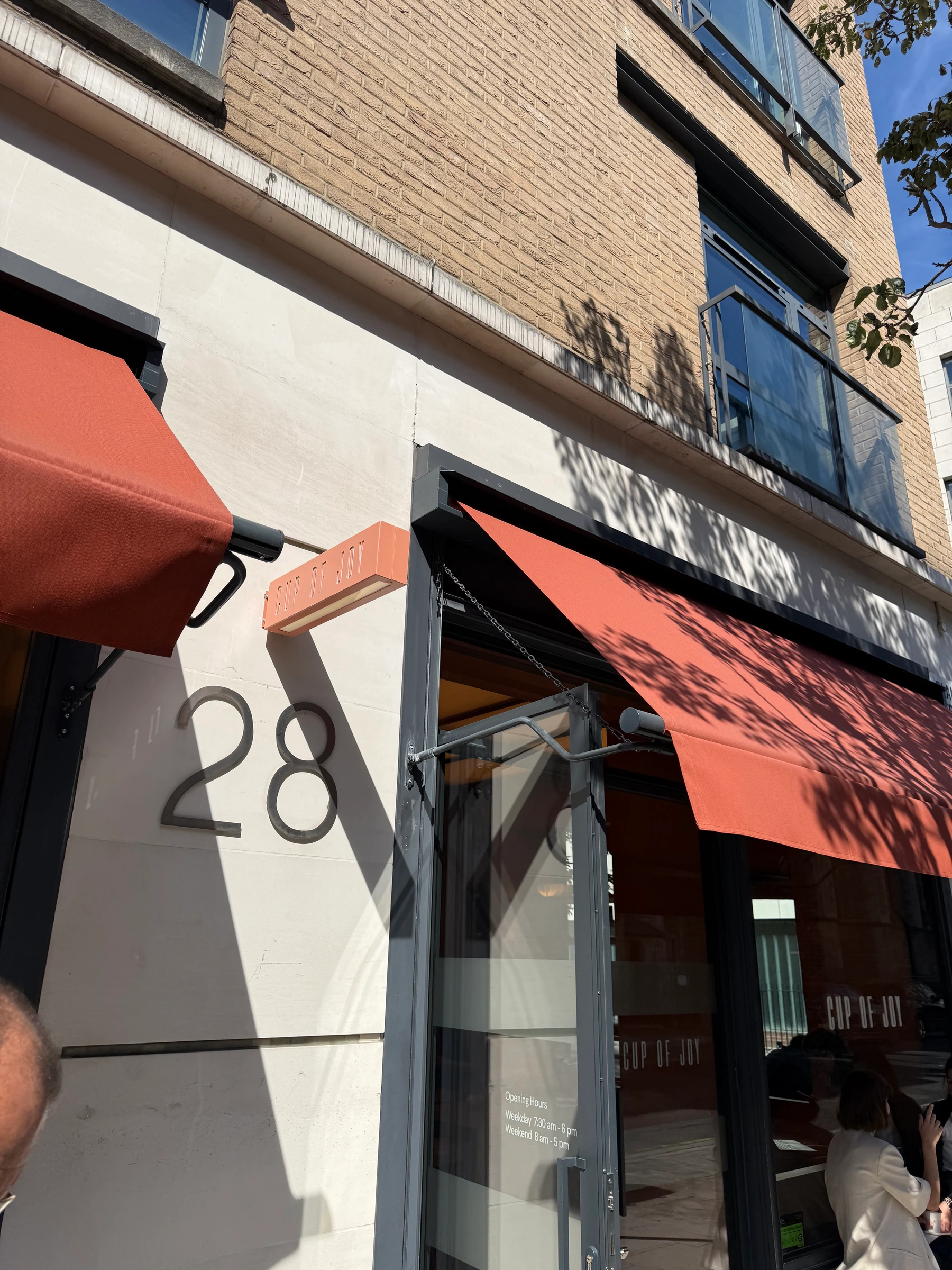
you'll find it at 28 blandford street, one minute from special guests, which means this whole block has quietly become one of the better reasons to come to marylebone.
the moment you walk in
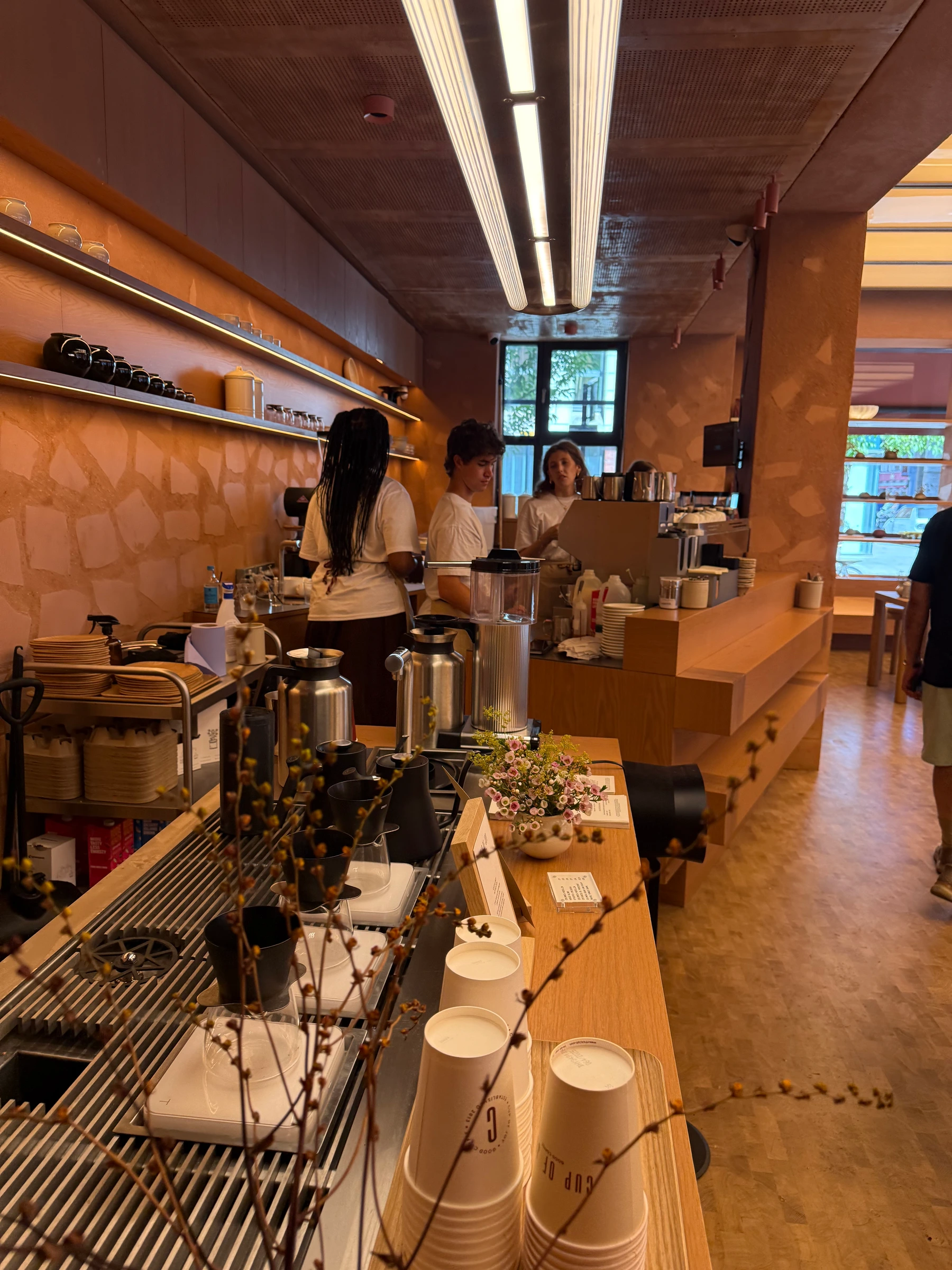
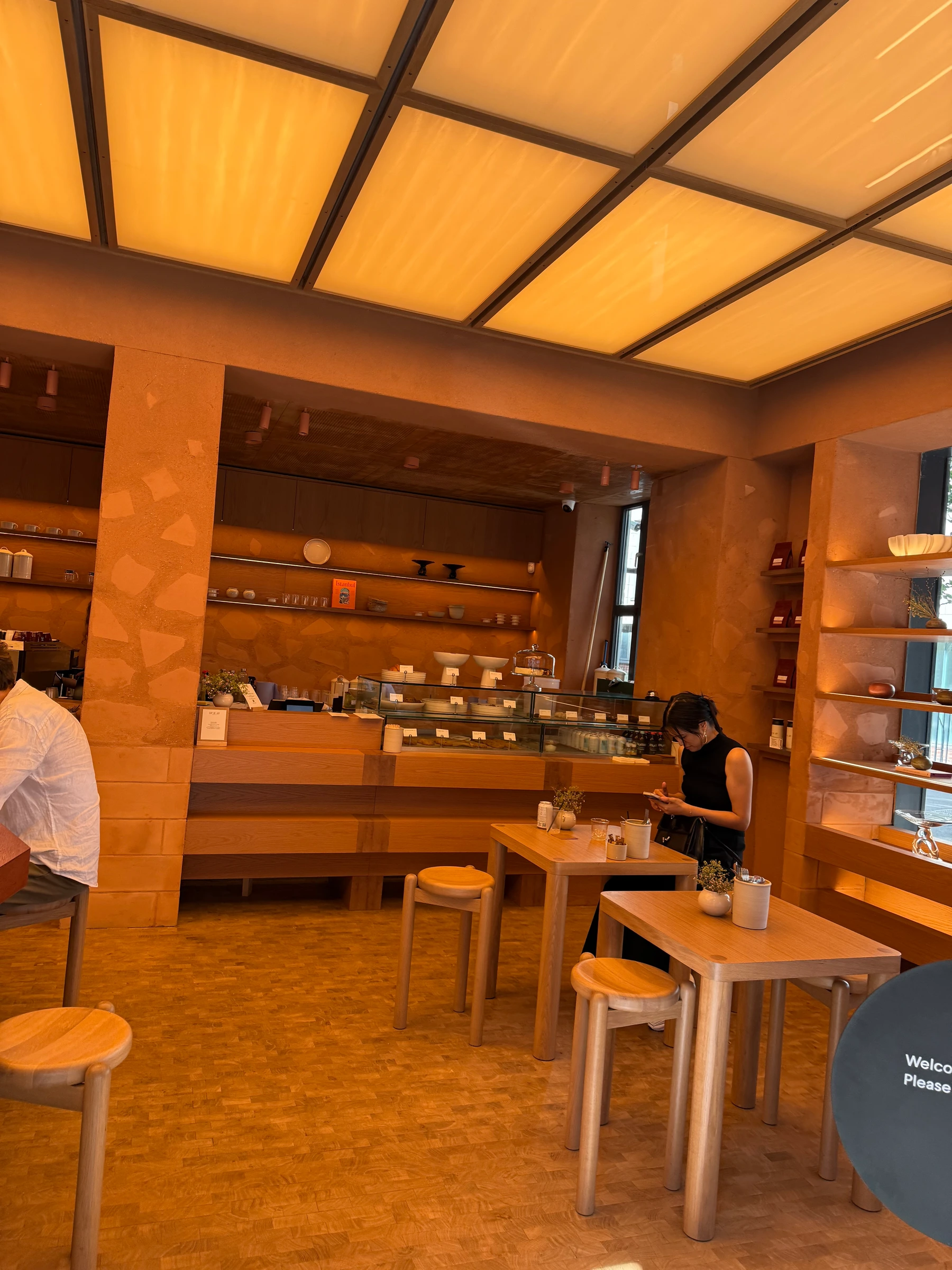
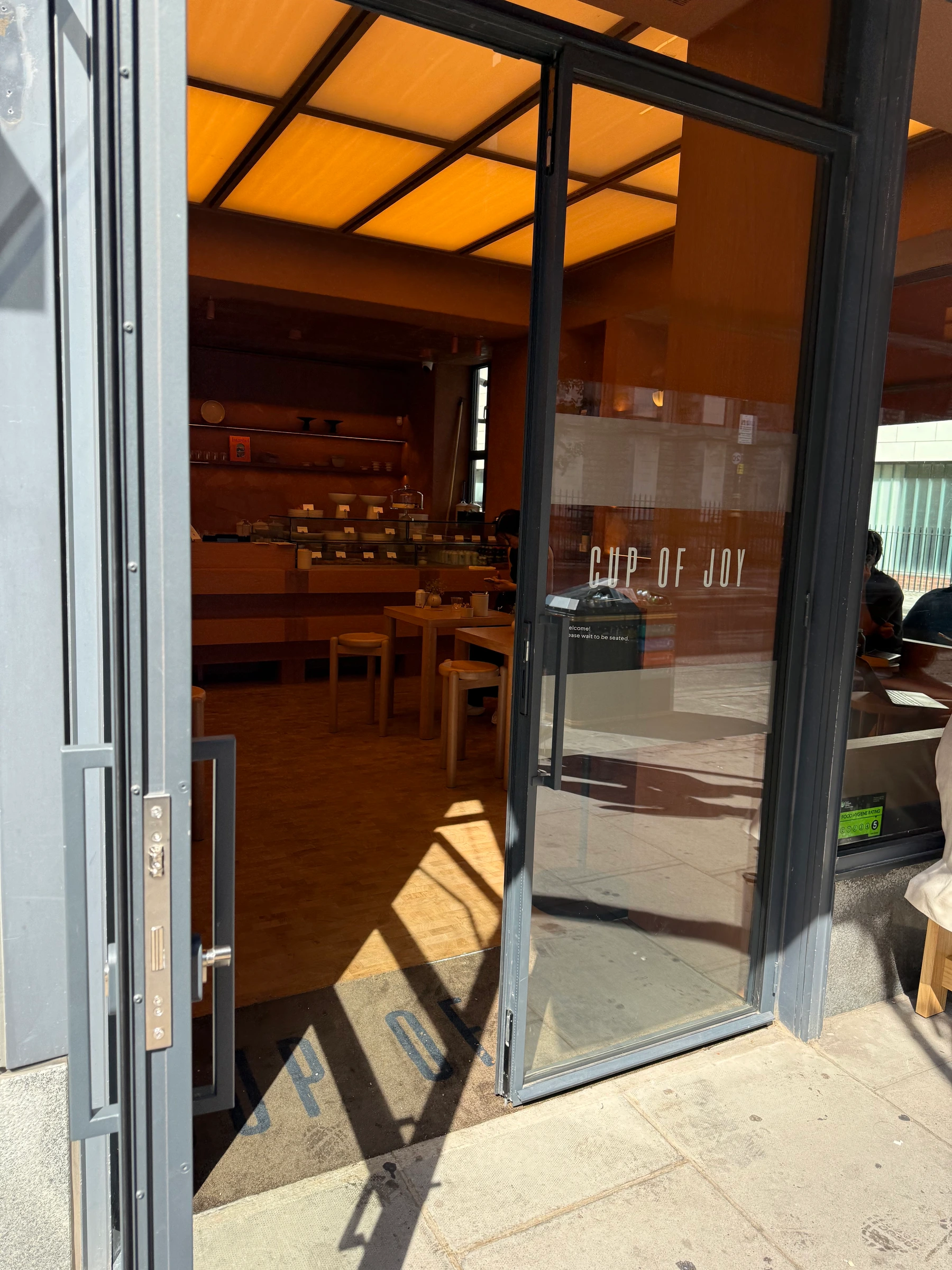
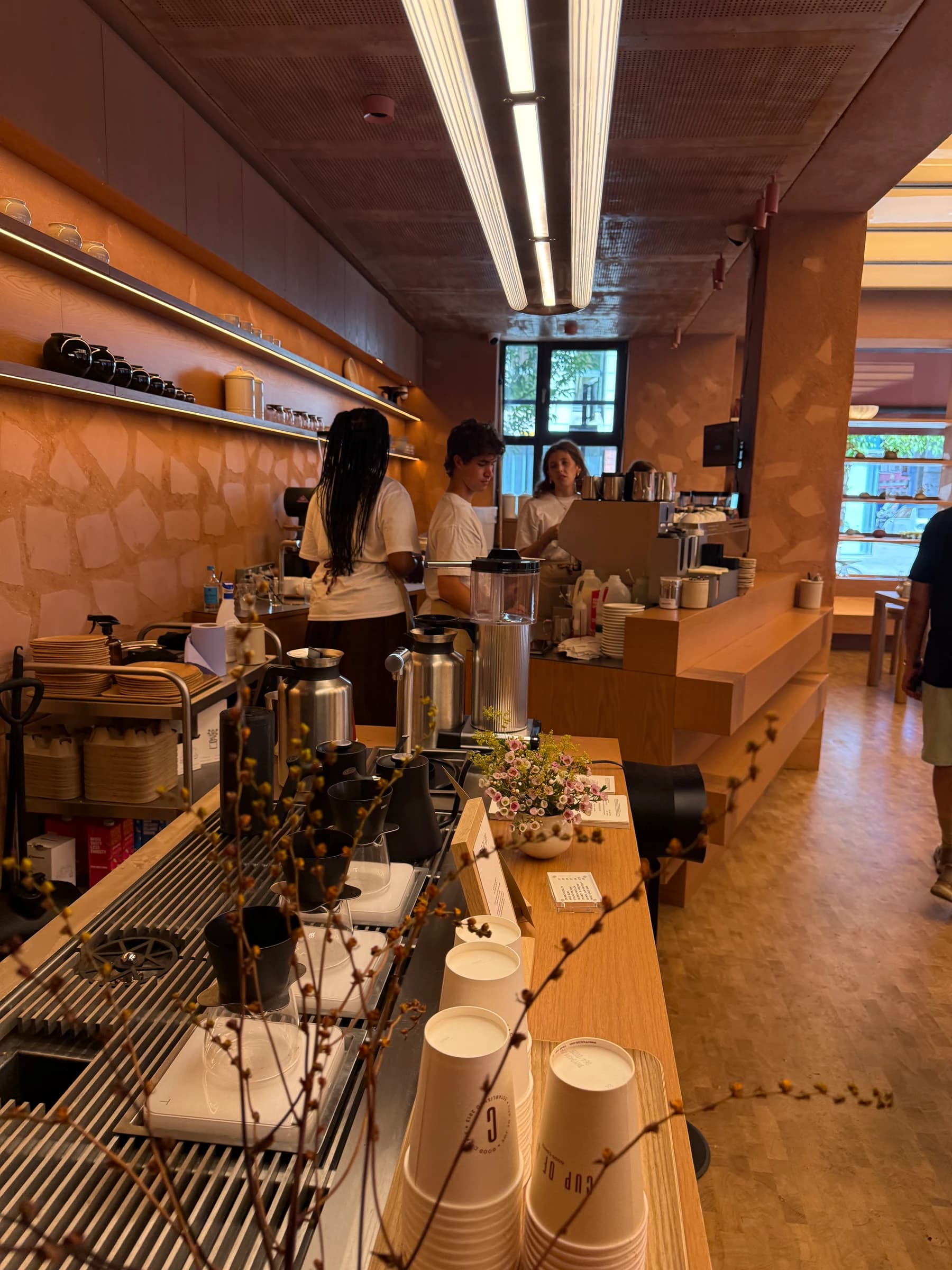
you'll find it at 28 blandford street, and you should know right away that special guests is literally a one-minute walk from here, which means this whole block has quietly become one of the better reasons to come to marylebone. cup of joy is new, and it feels it: the timber smell hits you first, clean and faint, the kind that fades within a few weeks of opening. it's not heavy or resinous, just that particular freshness that comes off new shelving before the coffee oils and foot traffic start layering over everything. then the room resolves itself. terracotta plaster walls in a mottled stone pattern, pale oak shelving, a cork-toned floor underfoot, and a big backlit ceiling panel that pushes warm light into every corner even on a bright afternoon. it doesn't fight the daylight. it just softens everything.
the door handle is cold metal, and the door itself is heavier than you expect. that's the first physical signal that something has been thought through here. the threshold between the street and the interior is immediate: outside you've got the low hum of blandford street, the occasional courier bike, the particular sound of marylebone at mid-morning which is quieter than the main drag of the high street but still present and human. inside, that sound drops. not because of acoustic treatment you'd consciously notice, but because the room's proportions and materials do quiet work. the cork-toned floor is part of it. so is the plaster, which is thick and matte and absorbs rather than bounces. by the time you've taken three steps in, the street already feels further away than it actually is.
blandford street itself rewards a moment of attention when you arrive. it's a short stretch, residential at the edges, with a few small independents trying to hold their ground. the kind of street that doesn't announce itself. cup of joy sits on it without overwhelming it, the shopfront clean-lined and restrained, the signage small enough that you could miss it if you weren't looking. that understatement continues inside. nothing in here is trying to impress you loudly.
what to order
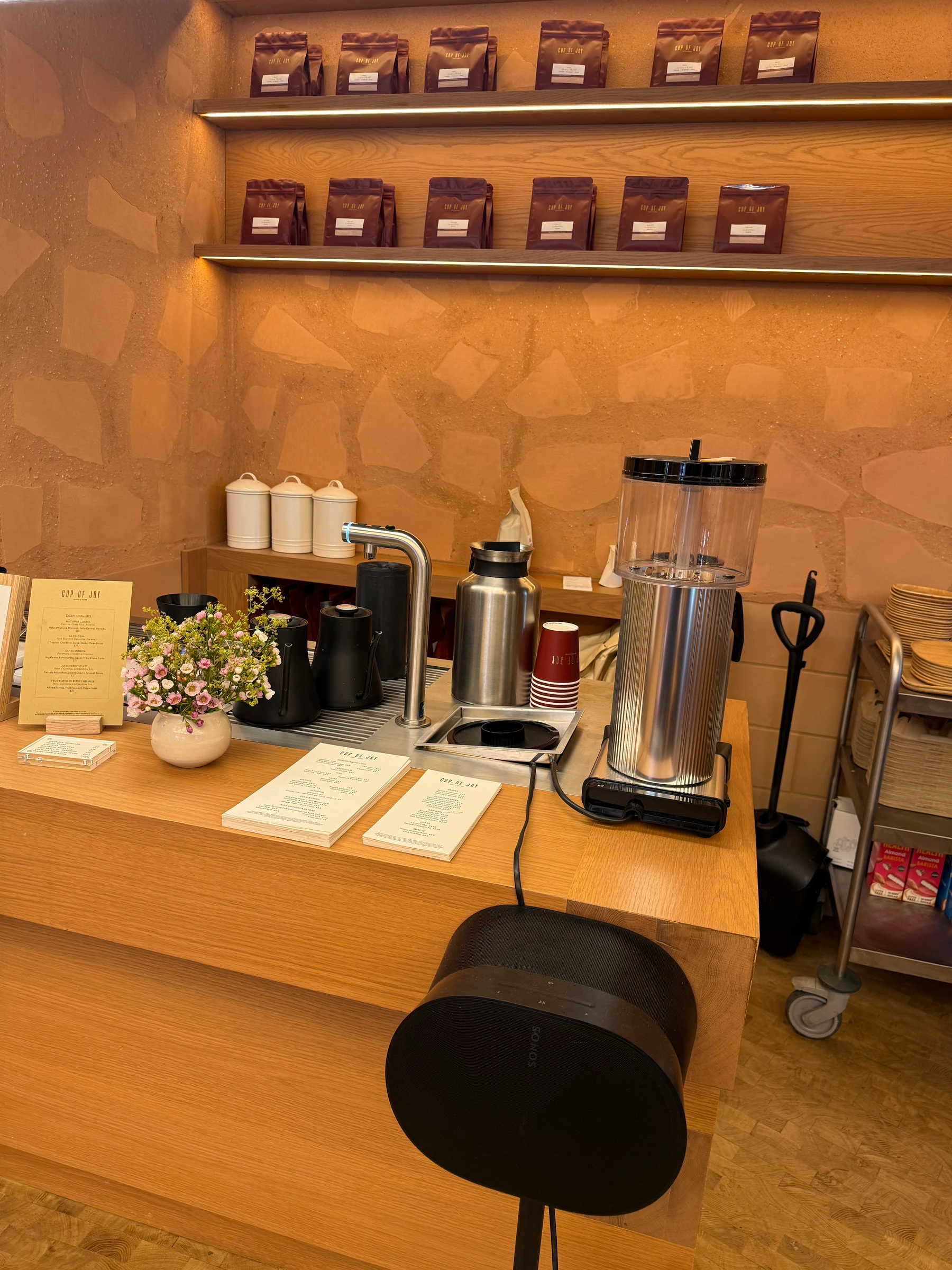
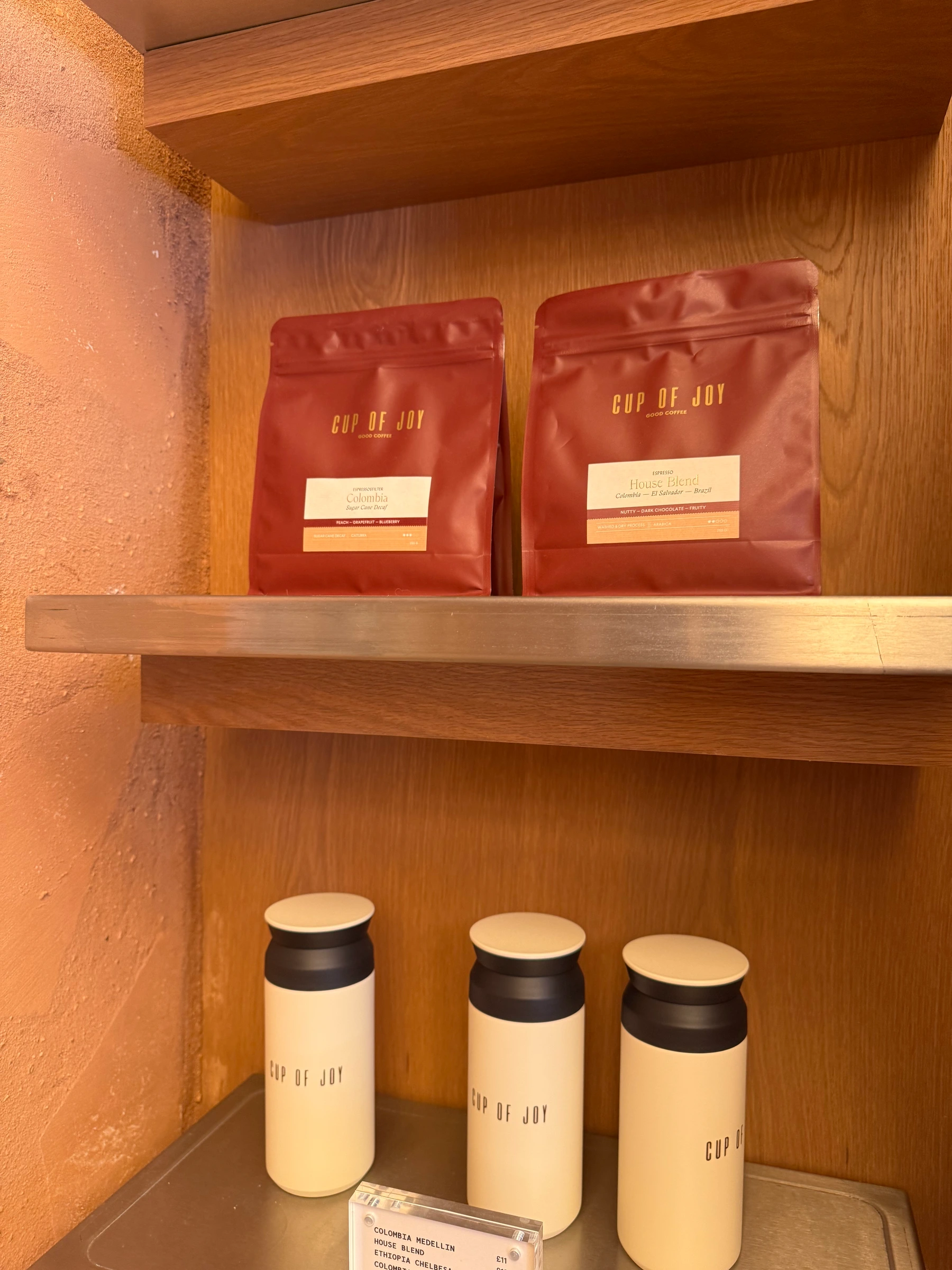
start with the espresso. it's properly good, which sounds like a low bar but isn't, because properly good means sweet and balanced rather than aggressive, the kind of shot that doesn't make you wince or reach for water. cup of joy roasts under their own name, and their house blend pulls together colombia, el salvador and brazil into something that reads dark chocolate and nutty, with a little orange brightness underneath. it holds up well as espresso. it'd hold up well as a flat white. don't overthink it.
the shot itself arrives in a small ceramic cup, white, no saucer fuss, just a single piece sitting on the bar or on your table depending on where you've settled. the crema is present but not foamy, which is the right call. the pull time, watching from a seat at the bar where you can see the machine clearly, looks to be sitting somewhere around twenty-eight to thirty seconds, which tells you the grind is dialled and nobody's compensating for a bad recipe by rushing the extraction. the first sip is the warmest and the brightest. by the third, you're into the chocolate and the nuttiness. it finishes clean. no sourness creeping in at the back. no bitterness that lingers and makes you want to rinse your palate with something cold.
the water matters here, though it's rarely the first thing people ask about. london water is hard, and hard water and espresso have a difficult relationship unless someone has dealt with it properly. the extraction tastes filtered, the mineral edge gone, which suggests a filtration setup doing its job quietly behind the scenes. you wouldn't notice if it were right. you'd absolutely notice if it were wrong.
the cold brew is clean. not complex, not trying to be, just cold and clear and exactly what you want if you're walking in off a warm afternoon. it's served in a tall glass, no ice watering it down, the kind of cold brew that's been brewed long and slow, probably somewhere between sixteen and twenty hours, and then refrigerated rather than iced. the clarity of it is what gets you. no murkiness. no sediment at the bottom of the glass. just coffee that happens to be cold.
get the carrot cake. it holds its own, which matters, because café pastries in london have a long history of being disappointing. this one isn't. the texture is dense without being heavy, the frosting restrained rather than cloyingly thick, and the spice in the cake itself is actual spice, not the suggestion of it. it comes on a small plate, a generous slice, and it holds together properly when you cut into it with the edge of a fork.
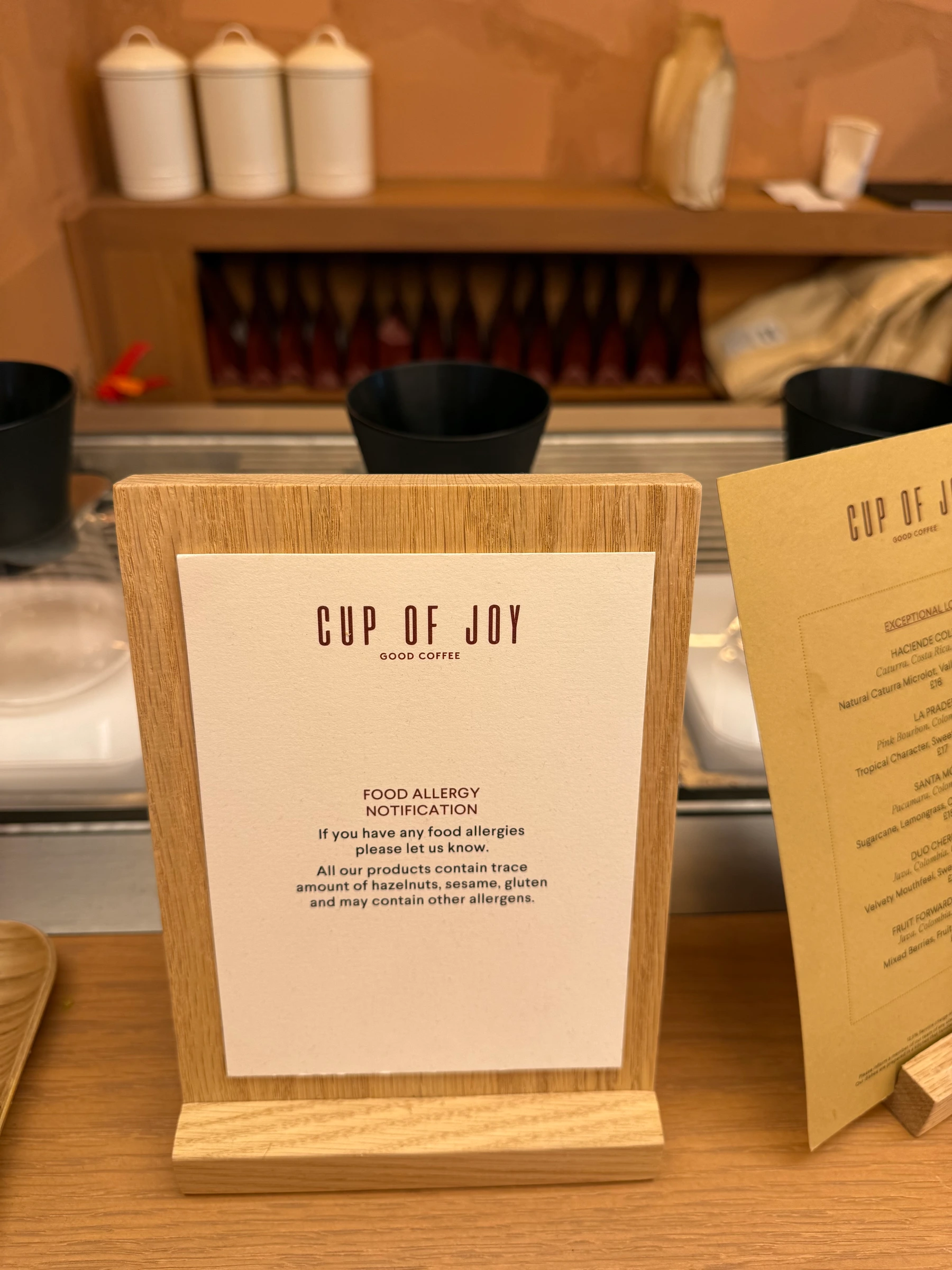
the pour overs are on the menu and they're the one thing i didn't get to. the single origins on offer include a colombia medellin, an ethiopia chelbesa, and a colombia sugar cane process decaf if you're cutting caffeine later in the day. those are the three to watch. the sugar cane process on the decaf is worth noting specifically: it's a solvent-free method that uses ethyl acetate derived from sugar cane fermentation, which tends to preserve more of the bean's original character than other decaf processes. the medellin and the chelbesa are the interesting contrast, a washed colombian against an ethiopian that will likely run floral and stone fruit depending on the roast profile. if you're going for the full sit-down experience, pair a pour over with the turkish eggs, served with sourdough pan-roasted flatbreads and aleppo pepper butter. the flatbread arrives warm and slightly charred at the edges, the aleppo pepper butter starting to melt into it by the time it reaches the table, the heat of the pepper sitting at the back of your mouth rather than the front, which is where aleppo tends to land. or the aegean morning, a sesame bagel with matured feta, heirloom tomatoes, olives, fresh thyme, and house-made pistou. the food's sourced through natoora and the marylebone farmers market, and it shows.
pricing sits where you'd expect for marylebone specialty: espresso around four pounds, pour overs likely in the six to eight range depending on the origin, food in the ten to fifteen territory for the plated dishes. nothing that'll surprise you if you've eaten or drunk coffee in this part of london before.
recommended order: espresso to start, pour over while you eat, carrot cake on the side.
the chef / the people
cup of joy started in bebek in 2013. bebek sits right on the bosphorus, and it's the kind of istanbul neighbourhood where specialty coffee found its footing in turkey early, before it became a widespread thing. cup of joy was part of that first wave, helping establish what modern specialty coffee could look like in a country with a very long, very specific relationship with how coffee gets made and served. eight locations in turkey across thirteen years. this is the first one in london.
that context is worth sitting with for a moment. turkey has been making and serving coffee for centuries, with traditions around preparation and ritual and the social weight of a coffee invitation that go far deeper than the current global third-wave conversation. coming out of that culture and choosing to build something that takes specialty coffee seriously without abandoning the hospitality instincts that underpin turkish coffee culture is a particular kind of balancing act. cup of joy seems to have managed it, at least in the marylebone space, where the service has the warmth you'd associate with somewhere that understands coffee as a social thing, not just a transaction.
the marylebone space was designed by benni allen of ebba architects, who spent time in istanbul before putting the room together. that context matters because the place doesn't feel like a generic london café wearing a foreign concept as a costume. it feels considered. the material choices trace back to something real: the terracotta plaster that runs the length of the walls is the colour of sun-dried earth, not the terracotta of a trend cycle, and the oak is pale and grain-forward rather than the dark or smoked oak that gets used when a room is trying to signal a particular kind of seriousness. these are warm materials that happen to work together, rather than a palette assembled to photograph well.
the people behind the counter on the day i visited were calm, unfussy, and knew the coffee well enough to answer questions without making you feel like you were being lectured. that's the bar. they cleared it. service at a new opening can go either way, and this one was in good shape. the bar itself is positioned so that the barista faces the room while pulling shots, which means there's a natural line of sight between the person making your coffee and the space you're sitting in. it creates a low-level sense of connection without anyone having to work at it.
the queue, the timing
it's just opened, so right now you can walk in and get a window seat. that won't last. the sort of opening this is, with the room it has and the block it's on, will be properly busy within a month. go now while you still can.
weekday mornings before ten are your best bet. the foot traffic on blandford street at that hour is mostly local: people moving through on their way somewhere, dog walkers making a loop, the occasional person who works nearby and has already made this part of their routine. it's quiet enough that you can hear the grinder from your seat, a short sharp burst, maybe eight seconds, the sound of a blade working through fresh beans. then the tamper. then the machine. there's a rhythm to it that's oddly settling when the room isn't full.
after ten the dynamic shifts. the marylebone lunchtime crowd starts warming up earlier than you'd think, and the room, which is relatively compact, tips from comfortable to full without much transition time in between. the window seats go first. then the bar stools. if you're coming on a weekend, come early or accept that you might be standing. the blandford street stretch is short on the kind of places you'd happily kill twenty minutes in while you wait, so if it's full, your best fallback is special guests, one minute in the other direction, which is already excellent and already has a queue of its own. plan accordingly.
the room
the bar runs the length of the space. batch brew sits at one end in a tall glass dispenser, the pastry case anchors the other end, and small oak tables and stools line the window. the batch sits under a small handwritten label, the kind of detail that suggests someone is paying attention to the small transactional moments, not just the espresso. the pastry case is lit from above and the carrot cake sits at eye level, which is either intentional or lucky. probably intentional.
it's the window seats that are worth getting. the backlit ceiling panel does something unusual: it creates a warmth that doesn't feel forced, not the yellow-bulb flatness of a lot of café interiors, but a diffused glow that makes the terracotta walls read amber rather than orange. sit at the window and you get two light sources working together: the panel above and the grey-white london light coming in from the street, and the room mediates between them in a way that keeps everything from tipping into either harshness or dimness. the oak of the table surface under your hands is smooth and slightly cool, and the stool height is right, which is more than you can say for a lot of café seating that makes you feel either too tall or too low relative to where your coffee sits.
the cork-toned floor absorbs the sound a little. it's quieter than it looks like it should be. the room is still tidy in the way new rooms are, everything in its place, no scuffs yet, no wear patterns on the floor. come back in six months and it'll have loosened up. right now it's crisp, and that crispness works in its favour.
the verdict
this is ten out of ten on vibe, on experience, and on the coffee itself. that's the honest read. cup of joy has opened well: the room is warm and thought-through, the espresso is genuinely good, the food has a point of view, and the whole thing feels like it belongs on blandford street without trying too hard to fit in.
it's not for anyone who needs background noise and a long communal table to settle into. the space is relatively compact, and when it fills up it'll fill up fast. it's for people who want a short, focused coffee stop, or a slow breakfast that earns its time. there's a particular kind of morning that this place is good for: the one where you have an hour and you want to use it properly, where the coffee is the point and the room doesn't get in the way. the oak table is small enough that you're not spreading out, but the window seat gives you enough to look at that you're not staring at the wall. it works.
the pour overs are the one thing still on my list. that's a return visit already written. go now, while the room is still quiet and the window seats are still yours for the taking.
the details
- address: 28 blandford st, london w1u 4bz
- area: marylebone, london
- visited: 2026-08-14