why yemeni coffee is like nothing else
yemeni coffee stands apart with its complex blend of fruit, chocolate, and wine-like flavors. ancient processing methods and high-altitude growing conditions make it truly unique.
in this guide
- the ancient roots of yemeni coffee
- what makes yemeni coffee taste so unique?
- yemen versus ethiopia: the flavour gap
- traditional processing methods
- challenges in sourcing yemeni coffee
- yemeni coffee in modern culture
- tasting notes: a sensory guide
- faq
- where does yemeni coffee come from originally?
- why is yemeni coffee so expensive?
- how is yemeni coffee processed differently from other origins?
- how does yemeni coffee compare to ethiopian coffee?
- where can i buy genuine yemeni coffee?
in the hushed corners of a bustling london cafe, a v60 bloom slowly releases its secrets. the air is thick with anticipation, as the first sips of yemeni coffee transport you straight to the terraced slopes of bura'a. it’s not a concoction found in your run-of-the-mill coffee shop. instead, think of rich dark chocolate, ripe fruits, and a whisper of wine as the cup cools. this isn’t engineered. it’s yemen’s heirloom beans and traditional drying methods creating an experience like no other.
the ancient roots of yemeni coffee
coffee as a traded commodity starts here. not in brazil, not in colombia, not in the gleaming roasteries of east london. yemen is where coffea arabica moved from wild plant to organised crop, and where the world first learned to drink coffee as something worth seeking out.
the port of mocha, on yemen's red sea coast, was for roughly two centuries the only place on earth where you could buy coffee. the ottomans, who controlled the region from the 16th century onward, understood exactly what they had and guarded it aggressively. exporting live plants or viable seeds was a capital offence for a stretch. the word "mocha" itself, now lazily applied to chocolate-flavoured espresso drinks in every chain cafe on the high street, is simply a reference to that port. the chocolate connection is not flavouring. it is memory. the beans that left through mocha tasted of dark chocolate, and the name stuck to the flavour long after the origin story was forgotten.
the dutch eventually smuggled seeds out in the 17th century, planting them in java. that is where the world's first coffee blend came from: mocha and java. two place names that still echo through every coffee menu you've ever read, even if neither origin appears on them anymore.
coffea arabica itself originates in ethiopia. yemeni traders brought it across the red sea and cultivated it in the terraced mountain highlands, where it has been growing, largely unchanged, for over five hundred years. those genetics matter enormously, which is something the coffee world has only recently started paying proper attention to again.
---
what makes yemeni coffee taste so unique?
the short answer is that almost everything about how yemeni coffee is grown is different from how specialty coffee is grown everywhere else.
start with the altitude. farms in regions like haraz, bani matar, and bura'a sit above 8,000 feet in some cases. that slows the development of the cherry dramatically, giving it more time to concentrate sugars and build complexity. the air is dry. the temperature drops at night. the trees are old.
then there are the varietals. yemeni coffee has never been modernised in the way that so much of the world's crop has. these are heirloom plants that predate any formal breeding programme. the genetic diversity within a single farm can be remarkable, which is part of why yemeni coffee resists easy categorisation. one lot from haraz might show floral, almost rose-like qualities alongside deep chocolate. a matari will be sharper, more pronounced. a sanani tends toward fruit. you are not tasting one variety, optimised for yield and consistency. you are tasting centuries of un-managed, gloriously uneven genetics.
there is also the hollow bean issue, which sounds like a defect but is actually just yemeni coffee being itself. a genetic characteristic of many local varieties leaves a portion of the bean's interior hollow. yields are lower as a result. but the flavour is not diminished. if anything, the concentration increases.
yemen versus ethiopia: the flavour gap
people often assume that because coffea arabica came from ethiopia, yemeni and ethiopian coffees should taste similar. they do not. if you have been drinking a lot of washed yirgacheffe, the first time you cup a yemeni natural from haraz will feel like a different category entirely.
| characteristic | yemeni coffee | ethiopian washed |
|---|---|---|
| body | thick, syrupy | light to medium |
| acidity | low to medium, integrated | bright, pronounced |
| fruit notes | dried fruit, raisin, fig | fresh citrus, berry, stone fruit |
| finish | long | clean, relatively short |
| chocolate | prominent | rare |
| florality | present in high-altitude lots | common, often dominant |
neither is better. they are genuinely different expressions of the same species, shaped by completely divergent centuries of geography and practice. but if someone tells you yemeni coffee is "just like an ethiopian natural," they have not had a good one.
---
traditional processing methods
there is no fermentation tank here. no raised bed with precise airflow and moisture monitoring. no washing station. the process that produces yemeni coffee is essentially the same one that has been used since the 15th century, and the reason it produces those flavours is precisely because nothing has been standardised.
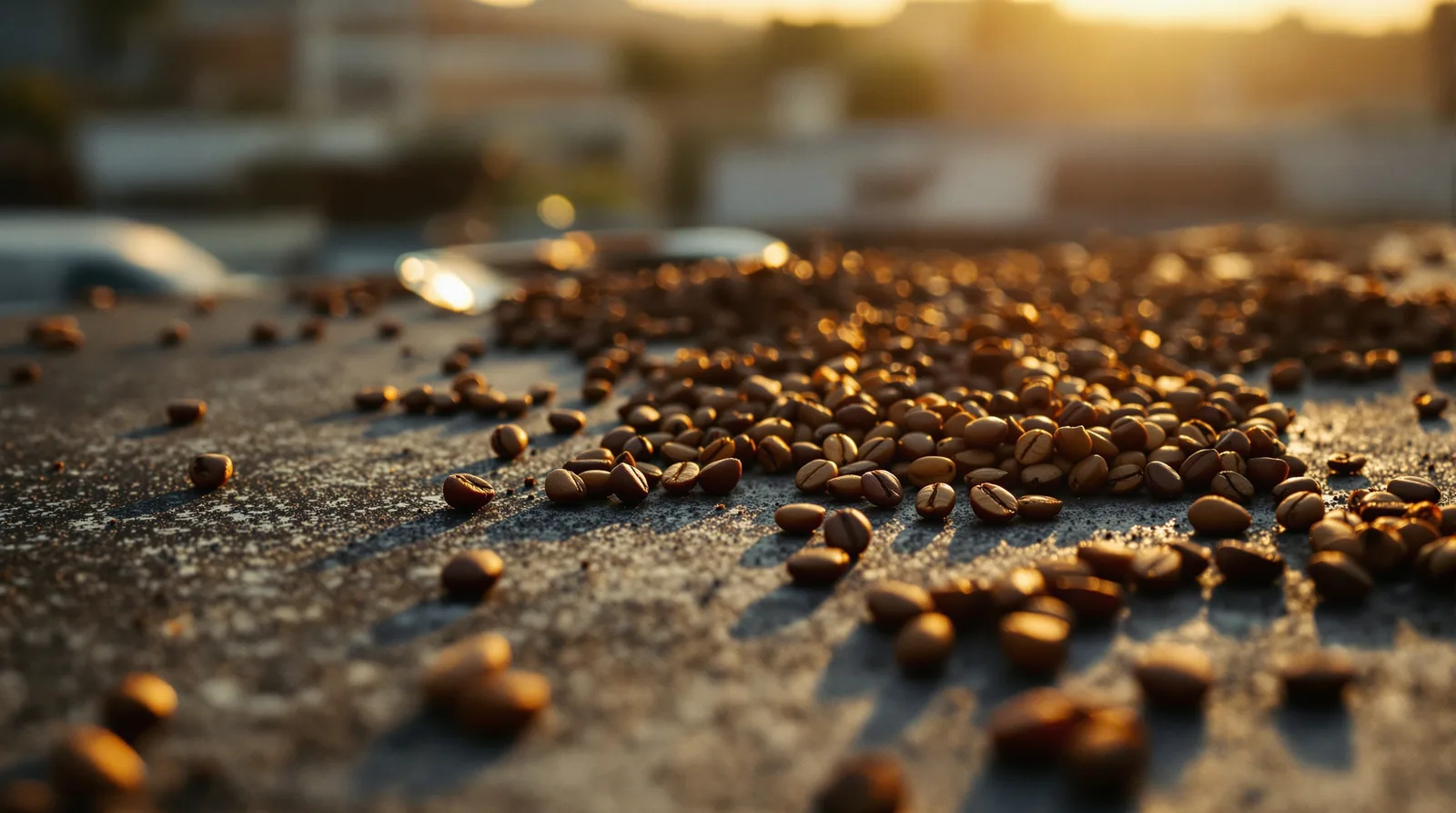
after harvest, which happens in autumn and is done entirely by hand (families who have worked the same terraces for generations, picking only the ripest cherries), the whole fruit goes onto rooftops. flat rooftops. in the sun. for about four weeks. the cherry dries around the bean, the sugars intensify, the fruit ferments gently in the warmth, and the bean absorbs those compounds directly. after drying, the husks are split open using millstones and the seeds cleaned by hand.
that's it. that is the process.
once the cherries are dried, the husk doesn't go to waste either. qishr, the traditional yemeni drink made from dried coffee husks brewed with ginger, has been drunk in yemeni homes for centuries. it is lighter than brewed coffee, warm and spiced, and it represents something that western specialty culture tends to ignore: the whole plant, not just the bean.
the inconsistency this produces is, depending on your perspective, either a flaw or the entire point. fathom coffee describes it well: yemeni coffee is unique in its inconsistency and irregularly shaped beans. an air of mystery surrounds every cup. that is not marketing copy. it is an accurate description of what you are getting into.
modern specialty processing is largely designed to remove that mystery. yemeni processing preserves it.
---
challenges in sourcing yemeni coffee
this is where things get genuinely complicated.
yemen has been in a state of civil war since 2014. the humanitarian situation is severe. trade routes are dangerous. export infrastructure is minimal. insurance costs for shipping are punishing. tariffs and trade bans create additional layers of difficulty at the border. even when coffee gets out, traceability is hard to maintain, and the risk of misrepresentation (bags labelled as yemeni that contain coffee from elsewhere) is real enough that experienced buyers are cautious.
the result is that yemen's coffee production is very low relative to international demand, and has been falling. what does get exported commands high prices, partly because of genuine quality, partly because of scarcity, and partly because the cost of responsible sourcing at origin is high when the logistics are this difficult.
mokhtar alkhanshali of mocha mill, who became the most visible face of yemeni coffee in the mid-2010s after his story was covered extensively by sprudge and others, talked about how yemen "gets a one-liner at best in english texts." the knowledge base is thin. the supply chain is fragile. and the farmers, working terraced plots that are inaccessible by any standard supply chain logic, are often the last to benefit financially from the premium prices their coffee commands.
a few things worth knowing if you are trying to source responsibly:
- ask for specific region provenance. "yemeni coffee" is not enough. push for haraz, bani matar, bura'a, haymah, or another named region.
- ask who the importer is. transparent importers will tell you.
- expect to pay for it. anything suspiciously cheap should make you suspicious.
- accept that supply will be irregular. if a roaster you trust says they're out, that's normal.
- be sceptical of very large quantities. yemen is a low-volume origin. anyone offering large, consistent supply year-round is worth questioning.
the quality ceiling on yemeni coffee is extraordinary. but the supply chain requires patience, and a degree of trust in the people you are buying from.
---
yemeni coffee in modern culture
something interesting has been happening in oakland and the wider east bay area for several years now. a wave of yemeni-owned coffee shops has taken root, operating in a way that is entirely distinct from the sterile white-walled aesthetic that defined a certain era of specialty coffee. these are places where community and coffee intersect differently, where qishr might be on the menu alongside a v60, where the coffee's origin is not a talking point but a matter of personal heritage.
it is a different relationship to the origin than most specialty cafes have. and it has started influencing how people think about what a coffee shop is for.
in london, the interest in yemeni coffee has grown steadily too, though supply constraints mean it appears on menus more sporadically than drinkers would like. when it does appear, it tends to command attention. i had a cup of haraz natural at a small shop on exmouth market a couple of years ago, the barista describing it simply as "winey and dark, it'll surprise you." it did. the kind of cup you think about for days.
blue bottle's partnership with mocha mill in the mid-2010s brought yemeni coffee to a much wider audience, though the price point reflected both quality and scarcity. the experience of drinking it, even at thirty-odd dollars a bag, was described by many as unlike anything else in their rotation. that attention did not disappear after the initial media cycle. if anything, it created a lasting curiosity that independent roasters and importers have been working to meet ever since.
---
tasting notes: a sensory guide
cupping yemeni coffee for the first time can be disorienting if your reference points are all washed east african or clean latin american coffees. the flavours are not delicate. they do not announce themselves one at a time. they arrive in a cluster, and they shift as the cup cools.
here is what to pay attention to, roughly in the order you'll notice it:
- the dry aroma: deep and earthy. dark chocolate and dried fruit before water even touches the grounds. sometimes a faint wood or tobacco note underneath.
- the bloom and wet aroma: the natural processing comes forward here. stone fruit, dark raisin, sometimes fig. in high-altitude lots from haraz, a subtle floral quality can surface.
- first sips (hot): body arrives first. thick, almost syrupy. the chocolate is prominent. acidity is present but low-key, woven in rather than leading.
- as it cools: this is where yemeni coffee reveals itself. a wine-like quality develops, complex and slightly fermented in the best sense. closer to a dry red wine than anything you'd usually associate with coffee. some lots go almost boozy without being unpleasant.
- the finish: long. a good yemeni coffee does not clean up quickly. the chocolate and dried fruit linger.
regional variation matters here. matari beans from the bani matar region carry a sharper, more pronounced character. sanani blends (coffees from the sana'a region and surroundings) tend toward deeper fruit. if you see haymah on a label, expect something wilder and earthier still.
one practical note on brewing: soft water makes a real difference with yemeni coffee. hard water tends to blunt the complexity. and rest your beans. some lots don't open up properly until week four or five post-roast, occasionally longer. do not rush it.
---
faq
where does yemeni coffee come from originally?
coffea arabica is native to ethiopia, but yemen is where it was first cultivated commercially and traded globally. from around the 15th century onward, yemeni farmers grew coffee in the terraced mountain highlands, and the port of mocha became the world's primary coffee export point for roughly two hundred years. the genetics of yemeni coffee are closely related to ethiopian varieties, but centuries of isolation and selective cultivation have produced something distinct.
why is yemeni coffee so expensive?
several things converge. production volumes are low because the farms are small, the terrain is difficult, and the traditional processing methods are labour-intensive. the ongoing civil war has made export logistics genuinely dangerous and costly, adding significant expense at every stage of the supply chain. and international demand for a limited supply naturally pushes prices up. when you pay a premium for a traceable yemeni lot from a reputable roaster, most of that premium reflects real costs rather than marketing.
how is yemeni coffee processed differently from other origins?
all yemeni coffee is naturally processed, meaning the whole coffee cherry is dried intact rather than having the fruit removed before drying. this happens on rooftops and terraces, in the sun, for around four weeks. the bean absorbs sugars and fermentation compounds from the surrounding fruit during that time, which is a significant part of what creates the wine-like, dried-fruit character that yemeni coffee is known for. the process has not changed materially since the 15th century, and modern processing techniques cannot replicate it.
how does yemeni coffee compare to ethiopian coffee?
they share a genetic ancestor but taste quite different. ethiopian washed coffees (yirgacheffe, guji, sidama) tend toward brightness, florality, and fresh citrus or berry notes with a lighter body. yemeni coffees are darker and heavier, with dried fruit, chocolate, and wine-like complexity, and a thicker body with lower acidity. if you are more familiar with ethiopian washed profiles, yemeni coffee will feel like a significant shift. neither is more "correct." they are different in character.
where can i buy genuine yemeni coffee?
look for specialty roasters who name specific yemeni regions (haraz, bani matar, haymah, bura'a) rather than just "yemen." transparent importers who can speak to traceability are a good sign. expect to pay somewhere between £20 and £40 for 250g of a well-sourced lot. be sceptical of anyone offering large quantities at low prices. supply is genuinely limited, and anyone with too much of it at too low a price is worth questioning. a handful of uk and us specialty roasters carry yemeni lots seasonally. check their websites and sign up for notifications, because good lots sell out fast.
so the next time you find yourself cradling a cup of yemeni coffee, take a moment. it’s not just a drink; it's a direct line to centuries of tradition. high altitudes, rooftop drying, and those heirloom beans have stories to tell. listen to the echoes of history in every sip and savor what modern methods can never quite duplicate.