matching grind size to every brew method
grind size can make or break your coffee. from aeropress to espresso, learn how to match your grind to your brew method for a perfect cup every time.
in this guide
- why grind size matters
- coarse grind for immersion methods
- medium grind for drip and aeropress
- a quick comparison
- fine grind for espresso and moka pot
- the ultra-fine grind of turkish coffee
- experimenting with grind size
- faq
- does grind size actually matter more than coffee quality?
- can i use a blade grinder for any of these methods?
- how do i know if my grinder can handle turkish coffee grind?
- why does my french press always taste muddy?
- how often should i recalibrate my grind setting?
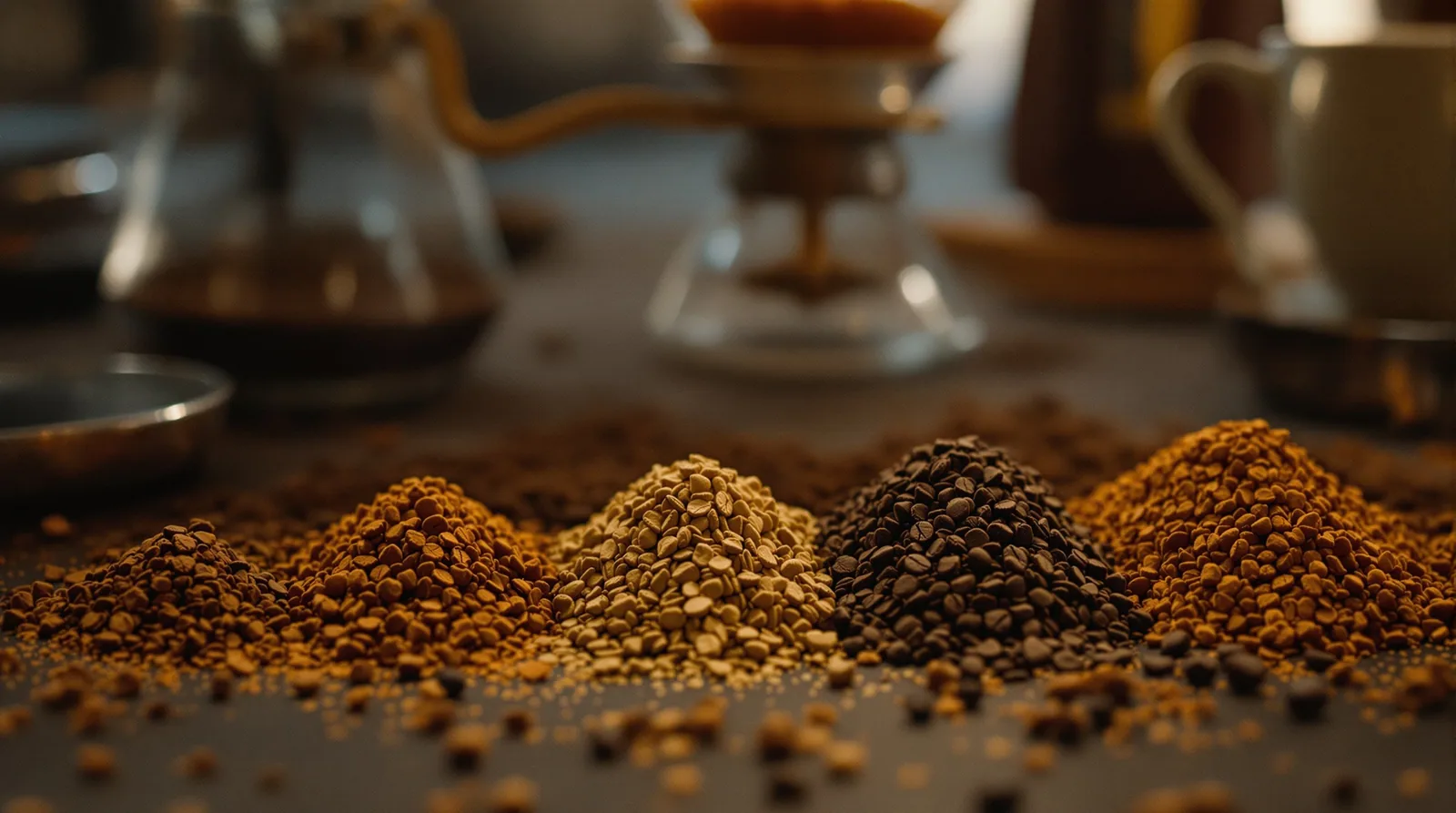
the smell of freshly ground coffee wafting through your kitchen is one of those little pleasures that kickstart a perfect day. but here's the thing: even the finest beans can fall short if the grind size is off. take the aeropress, for instance. a medium grind, similar to regular sand, offers just the right balance for its versatile brewing style. the same can't be said for turkish coffee, which demands the finest grind this side of powdered sugar. matching the grind to brewing method is more art than science, but it’s essential for a truly satisfying cup.
why grind size matters
surface area. that is the whole story, really. when you grind coffee, you break a bean into particles and expose the interior to hot water. finer particles have more surface area relative to their mass, so water extracts from them faster. coarser particles have less, so water needs more time. get the balance wrong and you are drinking either a sour, thin, underextracted cup or a bitter, drying, overextracted one.
genuine origin's grind guide describes it cleanly: too coarse, and you get sour and puckery. too fine, and you get harsh bitterness that coats your tongue. there is a useful analogy from peet's coffee about a glass of sand versus a glass of pebbles. pour water through sand, it slows right down. pour it through pebbles, it rushes through. coffee extraction works on exactly that logic.
the other thing people underestimate is grind consistency. a cheap blade grinder does not really grind, it smashes. you end up with a mix of fine powder and chunky fragments in the same batch. the fine bits over-extract, the chunky bits under-extract, and the cup is confused. investing in a decent burr grinder, even a hand grinder like a comandante or a timemore, changes things. you feel it the moment you start cranking, the resistance is even, the grounds that fall out look uniform.
---
coarse grind for immersion methods
think coarse sea salt. that is the visual reference you want when dialling in a french press or a cold brew. big, chunky particles. the kind that feel a little rough between your fingers.
why coarse? both french press and cold brew involve long contact times between water and grounds. a french press typically brews for around four minutes. cold brew sits for anywhere from 12 to 24 hours. with that much time, water will pull plenty from the coffee even through relatively large particles. go finer and you over-extract badly, producing a heavy, muddy bitterness. you also end up with sediment working its way through the mesh filter of a french press, and nobody wants grounds in their teeth at 7am.
cold brew actually wants an extra coarse grind, coarser than a standard french press. according to poverty bay coffee's brewing guide, cold brew grounds should sit closer to coarse kosher salt or even small pebbles, because the sheer length of steeping time compensates for the reduced surface area.
a few practical notes on immersion brewing:
- pre-wet your grounds (a quick stir before pressing the plunger helps even extraction in french press)
- use water just off the boil for french press, around 93-96 degrees celsius
- for cold brew, room temperature or cold water both work, cold water just takes longer
- always grind immediately before brewing if you can, not the night before
---
medium grind for drip and aeropress
here is where things get a bit nuanced. "medium" covers a lot of ground (sorry). drip machines, aeropress, some pour-overs, siphon brewers: they all sit somewhere in this range, but they are not all identical.
a standard auto-drip machine works well with a medium grind, roughly resembling regular sand. the aeropress is trickier. because you can brew it a dozen different ways, the grind size range is genuinely wide. honest coffee guide's grind chart lists the aeropress as spanning 320-960 microns, which is enormous compared to any other method. standard aeropress (one to two minutes, paper filter, plunger pressed straight down) lands best around medium to medium-fine. use the inverted method with a longer steep? you can go coarser. use a metal filter? go a touch finer.
pour-over devices like the hario v60 or kalita wave sit in medium-fine territory, around table-salt consistency. water flows through by gravity, so particle size directly controls flow rate. too coarse and your brew finishes in 90 seconds, thin and underextracted. too fine and you are waiting three and a half minutes, ending up with something harsh and overdrawn.
a quick comparison
| brew method | grind size | visual reference | approx. microns |
|---|---|---|---|
| cold brew | extra coarse | broken peppercorns | 1400-1600 µm |
| french press | coarse | sea salt | 1200-1400 µm |
| chemex | medium-coarse | kosher salt | 1000-1200 µm |
| auto-drip | medium | sand | 800-1000 µm |
| aeropress (standard) | medium | sand | 800-960 µm |
| hario v60 / kalita | medium-fine | table salt | 500-700 µm |
| espresso | fine | caster sugar | 200-400 µm |
| moka pot | fine-medium | fine sugar | 300-500 µm |
| turkish coffee | ultra-fine | flour or finer | 40-220 µm |
---
fine grind for espresso and moka pot
espresso is where grind adjustment becomes almost obsessive, and rightly so. a nine-bar pump forces hot water through a compressed puck of coffee in roughly 25-30 seconds. the only way extraction can happen properly in that window is if the particles are fine enough to create the necessary resistance and surface contact. get it wrong by even half a notch on your grinder and the shot pulls in 18 seconds flat, thin and sour, or chokes the machine at 40 seconds and tastes like burnt toast.
i once watched a barista at a small roaster-cafe on tassie street in fitzroy spend 20 minutes dialling in a new bag of ethiopian natural, adjusting the mazzer grinder a fraction at a time. "the beans are denser than last week's," she said, almost to herself, watching the shot drip into the demitasse. "need to go a touch finer." she was right. the next pull landed at 27 seconds, tiger-striped, with a hazelnut crema that lingered.
moka pot is sometimes lumped in with espresso, but it operates at lower pressure, somewhere around 1.5 bar rather than 9. a pure espresso grind can pack too tightly in the basket and either slow the brew to a crawl or cause the safety valve to blow. aim for something slightly coarser than espresso, a fine-medium that still feels quite powdery but not quite as dense. around 300-500 microns is a useful starting range.
how to dial in espresso grind size in order:
- pull a shot at your current grind and time it. note the yield and how the shot looks as it pours.
- if it runs fast (under 22 seconds) and tastes sharp or sour, grind finer by one small increment.
- if it runs slow (over 35 seconds) or chokes the machine, grind coarser by one small increment.
- change only the grind. do not adjust dose or yield at the same time or you will not know what caused the change.
- pull another shot. taste it. repeat until the timing and flavour align.
- once you find the sweet spot for this bag, write down the grinder setting. every new bag will need a fresh dial-in.
---
the ultra-fine grind of turkish coffee
turkish coffee operates differently from every other method on this list. grounds are not filtered out. they settle at the bottom of the cup and stay there, which means the grind has to be so fine it barely registers as a solid. we are talking 40-220 microns, approaching flour in texture.
the brewing vessel, a cezve (sometimes called an ibrik), holds ground coffee, water, and often sugar. the mixture is heated slowly, usually over low flame or hot sand, until it foams up. done right, the liquid in the cup is dense, intensely flavoured, and velvety in a way that no other method quite replicates.
the critical point is that this grind is almost certainly finer than what your home burr grinder can produce. most grinders bottom out around 200-300 microns. dedicated turkish coffee grinders, often small hand-cranked brass mills, can go significantly finer. if you are serious about turkish coffee and your current grinder cannot reach the required fineness, it is worth getting a purpose-built one rather than trying to force an espresso grinder to its limits.
one other thing: because the grounds stay in the cup, grind consistency matters enormously here. chunky particles floating in your cup are unpleasant in a way they would not be in a french press (where you at least try to filter them out). a uniform, powder-fine grind is the only way to get that proper settled layer at the bottom.
---
experimenting with grind size
the table above is a starting point, not a rulebook. roast level, bean density, altitude, humidity in your kitchen, the age of your grinder burrs: all of these nudge the ideal grind size. lighter roasts are denser and often benefit from grinding slightly finer than you would for a dark roast of the same bean. counter culture coffee's grind guide makes this point well: adjust one variable at a time, because if you change grind and dose simultaneously, you will not know which change did what.
practically, this means tasting critically. sour and thin? grind finer. bitter and drying? grind coarser. you are chasing something in the middle, a cup that feels balanced, where sweetness and acidity coexist without one bullying the other.
it is also worth knowing that water temperature and brew ratio interact with grind size. if your espresso tastes a bit flat but is running in time, try dropping the water temperature a degree or two before adjusting the grind. small changes stack. the point is not to find one perfect setting and stop there; coffee beans change week to week, season to season, and a grinder that was dialled in perfectly last month may need a nudge after the burrs accumulate a few more kilograms of beans.
the best thing you can do is keep notes. a small notebook next to your grinder, or even just a notes app. write down the coffee, the roast date, the grinder setting, and what the cup tasted like. patterns emerge quickly. you start to recognise what a one-notch adjustment feels like on your palate, and that knowledge compounds over time.
---
faq
does grind size actually matter more than coffee quality?
they work together rather than competing. the finest grind in the world will not save a stale or low-quality bean. but a great bean brewed with the wrong grind will still taste wrong: flat, sour, or bitter depending on the direction of the error. think of grind size as the mechanism that lets a good bean express itself properly.
can i use a blade grinder for any of these methods?
technically yes, but the results will be inconsistent. blade grinders produce uneven particle sizes in every batch, which means some grounds over-extract while others under-extract simultaneously. for french press or cold brew it is less of a problem because you are working with big particles and long brew times. for espresso or turkish coffee, it is basically unworkable. a blade grinder will not get fine enough or consistent enough for either.
how do i know if my grinder can handle turkish coffee grind?
check the manufacturer's spec sheet if you can find it. most domestic burr grinders list their finest setting in microns or at least describe it. anything labelled "turkish" in the grinder settings is a good sign. if your grinder only specifies down to espresso, it is probably not going fine enough. borrow or buy a dedicated turkish grinder before assuming your espresso grinder will cover it.
why does my french press always taste muddy?
usually one of three things. the grind is too fine and sediment is passing through the mesh. the plunger mesh has small tears or gaps. or you are pouring the coffee immediately after pressing and stirring up the settled grounds. grind coarser first (aim for big, chunky sea-salt-sized particles), press slowly, and let it sit for 30 seconds after pressing before you pour.
how often should i recalibrate my grind setting?
every time you open a new bag of coffee, check your grind and taste critically. even if you are buying the same coffee repeatedly, seasonal harvest variations and roast batch differences can shift the ideal setting by a notch or two. if your grinder has not been cleaned in a while, old coffee oil and fine dust can affect the grind quality, so a periodic brush-out helps keep things honest.
so, next time you reach for your coffee grinder, remember that the right grind size isn't just a detail, it's the canvas for your perfect cup. each brew method has its own grind personality, from the ultra-fine turkish to the chunky french press. tinker with grind sizes a bit, and you might just find your new favourite way to brew. coffee’s magic is in the details, after all.