dalgona coffee: four years after the tiktok storm
remember dalgona coffee's viral moment in 2020? the fluffy, whipped sensation that turned lockdown kitchens into makeshift cafes. fast forward to 2026, and dalgona has evolved. from peppermint to pumpkin spice, the whipped coffee craze isn't just surviving, it's thriving with new flavors and unexpected twists.
in this guide
- remembering the dalgona craze
- reimagining the classic: new flavors and techniques
- dalgona's influence on coffee culture in 2026
- the science behind the perfect whip
- dalgona at home vs. cafe experience
- faq
- what is the best coffee to use for dalgona in 2026?
- can you make dalgona without sugar?
- why did my dalgona foam turn out runny?
- is dalgona coffee actually a specialty coffee drink?
- how long does whipped dalgona foam last once made?
the hum of conversation blends with clinking cups at shoreditch grind, where customers eagerly cradle mugs of dalgona coffee. not just any dalgona, mind you, this is 2026, and the classic whipped coffee has undergone a renaissance. peppermint or pumpkin spice, anyone? the drink once synonymous with pandemic boredom has reinvented itself, earning a coveted spot on menus across the city. so what keeps this frothy confection from fading back into obscurity? it's the endless creativity of baristas and home brewers who've taken something once viral and made it something genuine.
remembering the dalgona craze
march 2020. the world locked down, and within about two weeks, half of instagram was covered in photos of stiff coffee foam perched on cold milk. google search data showed dalgona-related queries spiking 3,000 times their usual weekly volume by late march of that year. youtube videos with "dalgona" in the title saw views climb roughly 5,000 percent. these are not made-up numbers. that is a genuinely extraordinary thing to happen to a drink.
the formula was almost insultingly simple: two tablespoons of instant coffee, two tablespoons of sugar, two tablespoons of hot water, whipped until stiff, then spooned over milk. the technique has deep roots across south asia (where it goes by "beaten coffee" or "pheta"), greece (the frappé, dating to the 1950s), and libya. south korea brought it to global tiktok consciousness. the name itself came from a korean candy that the foam supposedly resembles.
what people forget is how quickly it faded the first time. restaurants reopened. the instant coffee base, fine for a lockdown novelty, felt thin once you'd had a proper flat white again. the whip was visually perfect and texturally pleasant for about three minutes before it dissolved into your milk and tasted like a slightly too-sweet iced latte. good enough for a tuesday morning with nowhere to be. less compelling when the world was moving again.
but the technique did not disappear. it waited.
reimagining the classic: new flavors and techniques
here is the thing about a foam that stiff: it is a vehicle. the original instant coffee formula was almost incidental. what mattered was the texture, and by 2024 people had started figuring out what else you could do with it.
the 2026 versions look almost nothing like the 2020 original, except in structure. baristas and home brewers have pushed the base into genuinely interesting territory, replacing granulated sugar with raw honey and a pinch of flaky sea salt (the salt knocks back bitterness in a way that actually works), swapping instant coffee for whipped espresso cream, or folding whipped coffee into ceremonial matcha for a two-tone layered glass that looks like something a prop stylist arranged.
some of the variations circulating right now:
- peppermint dalgona, built for winter menus, a drop of extract in the whip and a rim of crushed candy cane if you are into that
- pumpkin spice dalgona, which sounds obvious and is, but sells constantly in october
- dirty chai dalgona, where the whipped coffee sits on spiced masala milk instead of plain
- dalgona affogato, foam over a scoop of vanilla, the foam melting slowly into the cream
- salted honey whipped coffee, the one coffee people who dismissed the original might actually respect
- whipped matcha and espresso hybrid, two separate foams layered in the same glass
the move away from instant coffee matters most. whipping real espresso with sugar and a stabiliser (xanthan gum, or simply a bit of aquafaba) produces something richer and less synthetic. it solves the main criticism of the original. according to consumer data from tastewise, social mentions of dalgona coffee showed year-on-year growth of roughly 17% in early 2026, with peaks around january, which suggests people are treating it as a considered choice now rather than a trend they are catching up on.
dalgona's influence on coffee culture in 2026
dalgona did something lasting that has nothing to do with the drink itself. it made foam-as-topping normal. before 2020, if a specialty cafe in bermondsey or east nashville had put a whipped component on top of an iced drink, that would have been unremarkable. but dalgona made that gesture legible to a much wider audience. it told millions of people who had never thought much about coffee texture that texture was the point.
you can trace a direct line from the dalgona moment to the current obsession with layered drinks and what coffee trend analysts are calling the desire for "visual drama" in the cup. ube lattes, pistachio matchas, protein-infused cold foams, the whole category of drinks that are as much about how they arrive as how they taste. dalgona normalised that. it was the gateway.
cafes are also more willing to put whipped signatures on their menus as permanent fixtures rather than seasonal promotions. a barista at a small roaster on broadway market in london told me recently that their whipped hojicha topping, which they introduced as a weekend special, has become one of their most-ordered items on weekday afternoons. "people kept asking for it after the weekend," she said. "so we just kept making it." that is not a dalgona story exactly, but it is the same story.
the broader 2026 coffee scene, with its functional brews, adaptogen additions, and premium rtd products, has a lot going on. but the through-line is consumer confidence in asking for something specific and unusual. dalgona helped build that confidence.
the science behind the perfect whip
the original dalgona formula works because of the combination of instant coffee's soluble solids, sucrose, and the mechanical action of whipping. you are incorporating air into a supersaturated solution, and the coffee solids act as a partial stabiliser. that is why it holds its shape better than plain whipped cream.
how to get the texture right, in order of reliability:
- use a hand mixer or stand mixer. this is the most consistent method and takes about two minutes. the foam should triple in volume and hold stiff peaks.
- use a milk frother. handheld frothers work, though you will need to move in circles rather than up and down. takes four to five minutes.
- use a hand whisk. possible but slow. expect fifteen to twenty minutes of serious wrist effort for the full stiff-peak result. fine if you want the meditative experience.
- adjust your ratio. the classic 1:1:1 (coffee, sugar, water by tablespoon) is a starting point. more sugar gives more stability. less water makes a stiffer, more concentrated foam. if you are using honey instead of sugar, add slightly less water, as honey brings its own moisture.
- for espresso-based whips, you need a stabiliser. a quarter teaspoon of xanthan gum per two shots, or a tablespoon of aquafaba, gives you the structure that instant coffee provides naturally.
the sophisticated gourmet's original dalgona recipe remains one of the cleaner technical write-ups for the standard version, still being updated as of early 2026. temperature matters more than people realise: the hot water should be just off the boil. too cool and the sugar does not fully dissolve, which means a gritty foam with less stability. the milk below should be very cold if you are serving iced, to slow the foam from collapsing on contact.
the first time i made the honey-salt version at home, i used too much salt. the bitterness disappeared but so did everything else. a small pinch only. it is a supporting note, not a flavour.
dalgona at home vs. cafe experience
making dalgona at home is genuinely achievable, which is part of why it stuck. but the cafe version in 2026 is a different thing, and the gap has actually widened since 2020.
| | home | cafe |
|---|---|---|
| base | instant coffee or hand-whipped espresso | espresso-based with stabilisers, often house-made syrups |
| texture | variable, depends on your tools and technique | consistent, tighter peak, longer hold |
| flavour depth | limited by ingredients at hand | access to specialty ingredients, seasonal infusions |
| cost | pennies per glass | £5-8 in most uk cities |
| time | 5-20 minutes depending on method | ordered, made, served in under 3 minutes |
| satisfaction | high, especially if you nail it | high, different kind: someone else did the work |
the honest argument for making it at home is control and cost. you can dial the sweetness exactly how you want it, use your own milk, and have it ready before you have put your shoes on. the argument for ordering it at a place like shoreditch grind is that a good barista's version will be technically better than yours, almost certainly, and the ritual of sitting down with it matters.
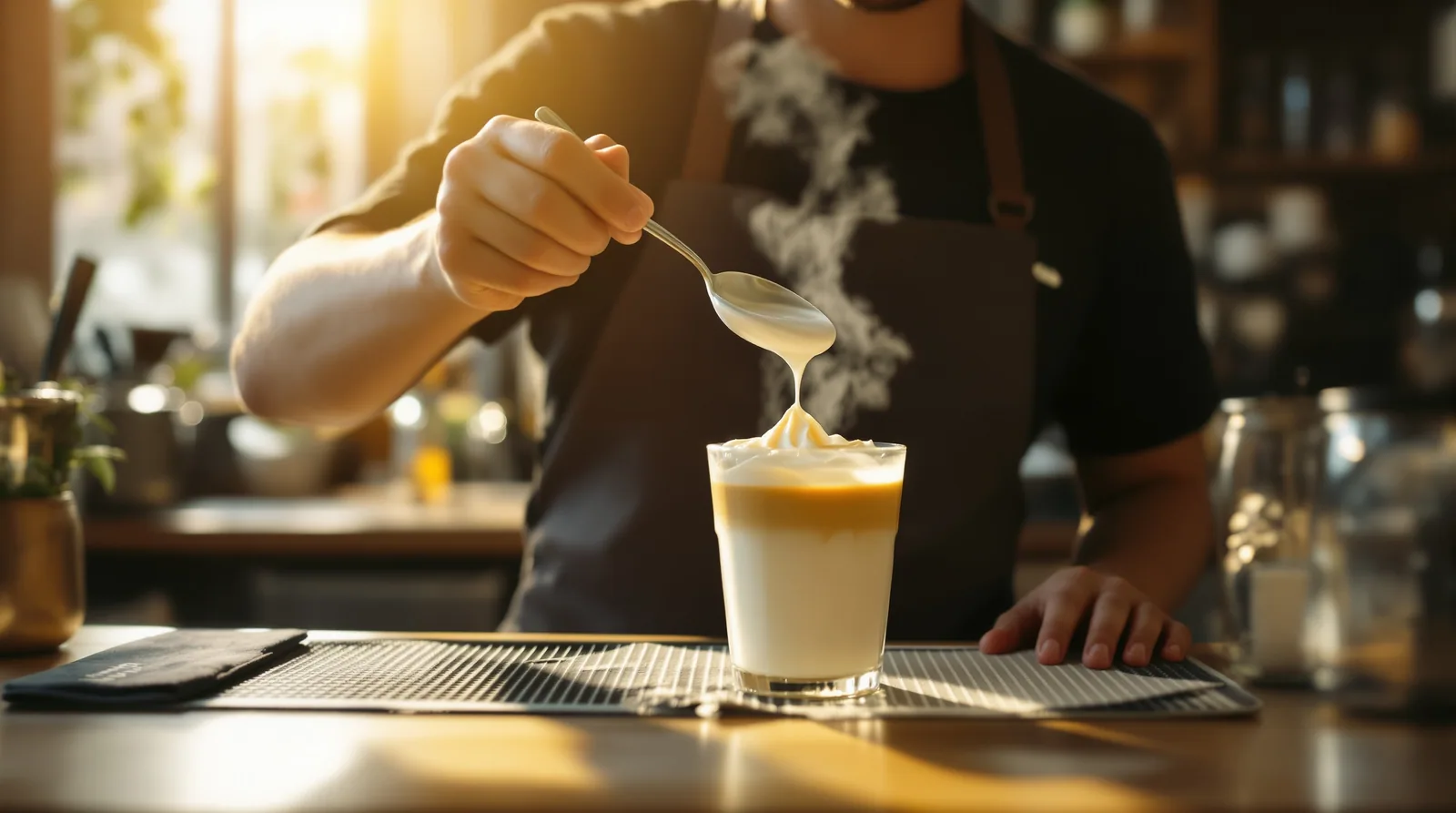
what cafes do that home setups cannot easily replicate is the layered build: cold-brew base at the bottom, sweetened milk, foam on top, a light dusting of something (cocoa, cardamom, miso powder) that dissolves into the first sip. the visual architecture of a well-made dalgona in a tall glass, backlit by a cafe window, is still one of the more photogenic things a barista can produce. that is not nothing.
the home version has its own charm, though. there is something satisfying about watching granules and sugar become a stiff meringue-like foam with your own hands. or your mixer's, anyway.
---
faq
what is the best coffee to use for dalgona in 2026?
instant coffee remains the most technically reliable base because the soluble solids help the foam hold its structure without additives. that said, the flavour ceiling is low. if you want a better-tasting result, whip two shots of espresso with a small amount of xanthan gum or aquafaba as a stabiliser. it takes more effort and the foam is slightly less stable, but the flavour difference is significant. for the standard home version, a good quality instant like a freeze-dried single origin (yes, those exist now) is a reasonable middle ground.
can you make dalgona without sugar?
you can, but the foam will be less stable and will collapse faster. sugar plays a structural role in the whip, not just a flavour one. if you are cutting sugar, the most workable substitute is a small amount of monkfruit sweetener combined with a stabiliser. honey works well and adds floral depth, though it also adds moisture, so reduce your water slightly. expect any sugar-free version to need drinking quickly before the foam deflates back into the milk.
why did my dalgona foam turn out runny?
a few likely culprits. the water was not hot enough (needs to be near-boiling to dissolve the solids properly). you did not whip long enough (the mix should triple in volume and hold stiff peaks, not just look fluffy). or your coffee-to-sugar ratio was off. too little sugar relative to coffee produces a foam that looks promising and then collapses. stick to equal parts coffee, sugar, and water until you understand how the mixture behaves, then adjust from there.
is dalgona coffee actually a specialty coffee drink?
not in the traditional sense. the original formula uses instant coffee, which most specialty roasters would not touch. but the technique has been adopted by specialty cafes using higher-quality bases, and the structural idea (a textured foam over cold or hot milk) is now firmly part of cafe vocabulary. it occupies an interesting position: too simple and sweet for hardcore specialty purists, but a genuine gateway for people who might not otherwise think about coffee texture or origin. in 2026, the specialty world has largely stopped sniffing at it.
how long does whipped dalgona foam last once made?
at room temperature, expect the foam to start breaking down within fifteen to twenty minutes, especially if the milk beneath is warm. in the fridge, a prepared foam (not yet placed on milk) will hold for up to two hours if covered, though it may need a quick re-whip before serving. the honey-salt version actually holds slightly longer than the standard formula, possibly because of honey's hygroscopic properties. if you are making it for guests, whip the foam first and refrigerate it, then assemble just before serving.
dalgona coffee's unexpected second act has proved that trends can have enduring life if given the right twist. just like the frothy peaks of this nostalgic drink, it's a reminder of how coffee culture continually reinvents itself. much like fashion, what was old is new again, each sip offering a comforting nod to the past with a hint of fresh innovation.