from 200kg to 2,000kg: scaling green coffee sourcing
scaling your green coffee sourcing isn't just about buying more beans. going from 200kg to 2,000kg a month is a game-changer, demanding shifts in logistics, quality control, and supplier relationships.
in this guide
- understanding the initial challenges
- logistics of large-scale sourcing
- maintaining quality at higher volumes
- building and managing supplier relationships
- balancing blends and taste consistency
- personal stories from roasters
- faq
- how far in advance should i be planning green coffee purchases at 2,000kg a month?
- do i need to start doing direct trade at this volume?
- what certifications should i be thinking about when scaling up?
- how do i handle it when a green coffee lot i contracted doesn't cup well on arrival?
- is it worth hiring a dedicated green buyer at this scale?
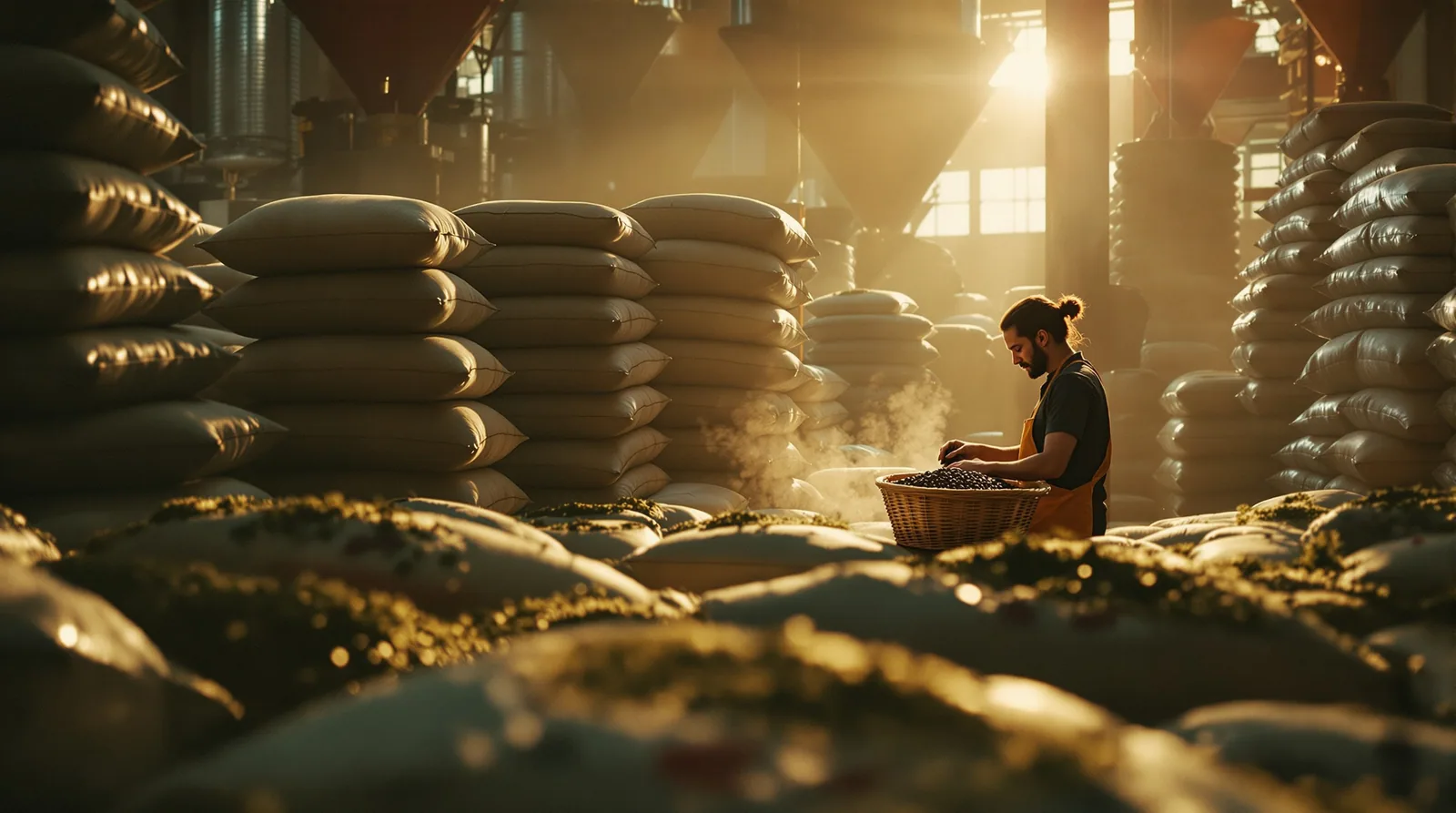
ever stood in a coffee warehouse, surrounded by the earthy aroma of sacks filled with green beans? picture the scene at portland coffee roasters, where mark stell faces a daily balancing act. as the demand shifts from 200kg to an impressive 2,000kg monthly, the challenges, and the stakes, grow exponentially. it's not just about filling more orders. the rhythm of sourcing and logistics transforms into an intricate dance involving quality control, supplier dynamics, and ensuring every cup tastes as memorable as the last.
understanding the initial challenges
the jump from 200kg to 2,000kg a month sounds like a logistics problem. it's not. or at least, it's not only that. the real friction happens earlier, in the assumptions you've built your sourcing around that quietly stop working once volume goes up.
at 200kg, you can afford to be scrappy. you cup a sample, you love it, you order a bag or two from an importer and see how it sells. lead times feel manageable. you probably keep one or two origins you rotate seasonally, maybe a house blend built on a trio of reliables. the operation fits in your head.
ten times that volume, and the margin for improvisation evaporates. according to perfect daily grind, roasters scaling up need to balance customer demand against responsible sourcing commitments simultaneously, which at higher volumes means those two things start pulling in opposite directions more often. a crop underperforms. a producer you've relied on gets a better offer from a larger buyer. your importer can't fill the order in time. at 200kg, you absorb that. at 2,000kg, it shuts down your production schedule.
there are a few challenges that surface almost universally at this scale:
- cash flow pressure. larger orders mean paying for more green coffee up front, often 60 to 90 days before it generates revenue.
- storage constraints. you need actual warehouse space, not just a corner of the roastery floor.
- forecasting accuracy. at small volumes, an overestimate is a minor inconvenience. at scale, it ties up capital in ageing green stock.
- sourcing pipeline depth. one or two origin relationships isn't enough. if a harvest disappoints, you need a bench.
none of these are insurmountable. but roasters who treat the scale-up as a simple multiplication, just order more of what you already buy, tend to hit them hard and fast.
---
logistics of large-scale sourcing
here is the thing most small roasters don't know until they're already at scale: shipping consolidation changes everything about your economics.
at 200kg, you're probably buying through an importer who holds stock domestically. quick turnaround, spot pricing, no minimum container requirements. that flexibility costs you. once you're ordering at 2,000kg monthly, you have the volume to think about full container loads or at least shared containers with much better terms.
juan (a sourcing consultant quoted in perfect daily grind's sourcing piece) puts it plainly: "the more green coffee you have in one container, the more you dilute the price of it. the greater the volume you move, the more efficient you are with your space and transportation." larger, less frequent shipments beat smaller, frequent ones once the numbers are right.
what that actually means in practice:
- plan your purchasing calendar 6 to 12 months out. origin seasons are fixed. ethiopia's main harvest arrives in q1. central american coffees follow in q2 and q3. you need to be placing pre-harvest contracts, not reacting to what's available spot.
- build storage for 2 to 3 months of forward green stock. this buffers against shipping delays (and there will be shipping delays) and lets you negotiate purchase timing rather than scramble.
- audit your importer relationships. some importers who serve you well at small volumes aren't structured for the regularity and documentation you'll need at larger scale. this is not a criticism of them; it's just a different business.
- track every shipment's lead time, not just the quoted one. your real lead time, port to roastery, tends to run longer than expected. build that into your ordering model.
- consider direct or semi-direct import for your highest volume skus. the paperwork is real, but so is the margin improvement and the relationship depth you get with producers.
the coffee supply chain at scale rewards roasters who can commit to volume. exporters and producers both respond to predictability. if you can tell a producer in huila or sidama that you'll take x bags per harvest for the next three years, you become a different kind of buyer.
---
maintaining quality at higher volumes
quality control at 200kg is mostly sensory. you cup everything before it goes into production, and if something's off, you catch it quickly. the loop is tight.
at 2,000kg, the same instinct needs a system behind it. because you're holding more stock, receiving larger shipments, and possibly working with a wider range of origins, the number of points where quality can drift quietly upward. a bag that's been stored slightly too warm. moisture migration in a shipment that was fine when it left origin but arrived subtly changed. a new importer lot that cupped well on the sample but landed at a different score.
the practical layer you need to add:
- receiving protocols. every shipment gets cupped before it enters production stock. not just sampled; cupped properly.
- moisture tracking. green coffee should sit between 10% and 12% moisture. get a decent moisture meter and log readings on arrival and periodically during storage.
- lot separation. even if you're buying 20 bags of the same origin, if they come from different harvest lots, track them separately. the cup profile can differ.
- a cupping log that actually gets used. not a spreadsheet that no one updates; a real record tied to specific bags and storage dates.
the sustainable restaurant association's sourcing guidance notes that third-party certifications provide a layer of verification that internal quality processes alone can't replicate. at volume, certifications like rainforest alliance or organic certification also become more practically useful, since they require documented traceability that strengthens your own quality audit trail.
one roaster i spoke to at a trade event in manchester described the moment she realised their informal cupping setup wasn't scaling: "we had a 60-bag lot of a washed yirgacheffe that we'd loved on sample. four weeks into using it, someone on the team said it tasted flat. we pulled the logs and had nothing. no arrival cup score, no moisture reading. we had 40 bags left and no baseline to work from." they rebuilt the whole intake process after that. the hiss of the grinder and the bloom in the cup now happen before anything touches the roast schedule.
---
building and managing supplier relationships
at small volumes, your supplier relationships are friendly and transactional. you email, they send samples, you order when you need to. it works because neither side is dependent on the other.
scale that up and the dynamic shifts materially. at 2,000kg a month, you are a meaningful customer to most mid-size importers. you have leverage, but you also have obligations. suppliers at this level expect predictability. ghosting them between orders, cherry-picking only their best-cupping lots, or habitually asking for last-minute changes to orders will damage relationships that take years to rebuild.
here is a comparison of what supplier dynamics typically look like at each scale:
| factor | 200kg/month | 2,000kg/month |
|---|---|---|
| typical buyer type | spot buyer | contracted buyer |
| pricing mechanism | importer list price | negotiated + pre-harvest contracts |
| relationship depth | account manager level | direct importer or exporter |
| lead time expectation | 1 to 3 weeks | 3 to 6 months (pre-harvest) |
| payment terms | standard net-30 | often requires deposit upfront |
| traceability documentation | basic | full lot traceability expected |
| origin trips | rare | increasingly common |
the sourcing team at kaldi's coffee in st. louis describes their supply chain as "an ever-expanding, ever-deepening network of relationships" built with importers, processors, and growers over years. that language is accurate at scale. the network doesn't just grow wider; it gets more complex to manage.
at 2,000kg, you should be working toward having at least one direct or semi-direct relationship per major origin region you buy from, supported by two or three importer relationships for flexibility. the arcadia green coffee model, as explored in the map it forward podcast, explicitly avoids buying from stock and instead matches specific coffees to specific roasters before committing to a purchase. that approach requires relationship depth that takes time to develop but pays back in consistency and traceability.
paying on time matters more than you think. a producer or exporter who knows you pay within terms will prioritise your pre-contracts and alert you first when exceptional lots come available.
---
balancing blends and taste consistency
blends are where the tension between scale and quality becomes most visible to the customer. a customer who's been buying your house espresso for two years has a sensory expectation built in. they know the weight of it on the back of the tongue, the specific point where the caramel note drops off. if your sourcing changes and the blend drifts even slightly, you will hear about it.
the challenge is that blend consistency at scale requires ongoing sourcing of several components simultaneously, each from a different origin and harvest cycle. when one component runs out and a new crop lot arrives, the cup profile of the new component almost certainly won't match the old one exactly. that is not a failure; it is the nature of agricultural product. but it requires active management.
how roasters typically handle this:
- overlap sourcing of blend components. before your current lot of, say, the brazil natural that anchors your espresso blend runs out, have the next lot in-house and cup it against the current one. adjust the blend ratio to compensate for profile differences before the old stock depletes.
- build a sample library. retain a sealed portion of each blend component lot. if a customer calls about a taste change six weeks after a lot transition, you can actually go back and compare.
- set a sensory target, not a fixed recipe. describing your house espresso as "dark chocolate body, orange peel finish, medium brightness" is more useful than locking in a 60/40 brazil/colombia ratio when the inputs change each harvest.
- brief your wholesale accounts. if a blend is going through a planned transition, tell your cafe accounts before it happens. a barista who knows the new lot is slightly more acidic can adjust their extraction; one who doesn't will just be confused.
kaldi's coffee articulates this well: their 700 blend is described not by its components but by its target profile, "classic chocolate and caramel taste with uniquely fruity notes." the sourcing follows the target, not the other way around.
---
personal stories from roasters
talk to enough roasters who've gone through this and a few themes come up again and again, usually delivered over a cold brew at the end of a trade show day, when the professional polish wears off.
one roaster who runs a 500kg-per-week operation out of a converted unit in ancoats told me that the hardest part wasn't logistics or quality control. it was the identity shift. "when we were small, i cupped everything personally. i knew every bag we had. scaling up meant building a team and trusting their palates. that's uncomfortable when the coffee is your name on the bag." he handed off green buying to a q-grader he'd worked alongside for three years, but it took six months of parallel cupping sessions before he trusted the handover fully.
another roaster, based in edinburgh and supplying around 30 independent cafes across scotland, described the cash flow shock of moving to pre-harvest contracts. "you're paying for coffee that won't arrive for four months and won't be roasted for five. your accountant looks at you like you've made a terrible decision." the offset, she said, was that the farm she contracted with in nariño started offering her first refusal on their competition-grade micro-lots, exactly because she'd committed to buying their larger commercial lots at a fixed price.
there is also the question of what augusto amaya of arcadia green coffee calls "no wasted coffee." as sourcing volumes grow, the cost of buying the wrong thing, a lot that doesn't move, a blend component that sits in the warehouse for eight months, becomes significant. matching coffees to your actual roasting profile and customer base before you commit to a volume purchase is a discipline that small roasters rarely need but large ones can't afford to skip.
the common thread across all of these stories: scale forces you to make explicit the things you previously kept implicit. your quality standards, your supplier expectations, your blend targets, your financial tolerance for forward contracts. getting those things out of your head and into a system isn't a betrayal of the craft. it's what makes the craft sustainable at volume.
---
faq
how far in advance should i be planning green coffee purchases at 2,000kg a month?
for your core, high-volume origins, you should be looking at pre-harvest contracts placed 6 to 12 months out. for more speculative or seasonal additions, 3 to 4 months is a reasonable minimum. the practical reality is that the best lots from well-regarded producers get allocated early in the harvest cycle. if you're placing orders only when you need stock, you're largely buying what others didn't want.
do i need to start doing direct trade at this volume?
not necessarily. plenty of roasters operating at 2,000kg or more source entirely through importers and do so with integrity and quality. what changes at this volume is that you have enough purchasing power to go direct if you want to, and some origins or relationships will reward it. the more honest framing is that at this scale you should be sourcing with enough intentionality that you could describe the full chain of custody for every lot you buy, whether or not you sourced it directly.
what certifications should i be thinking about when scaling up?
fairtrade, rainforest alliance, and organic certifications are the most widely recognised, and depending on your wholesale accounts, some customers will require them. beyond compliance, third-party certifications are useful because they create documented traceability that strengthens your own quality and ethics story. at high volume, that documentation also makes due diligence easier when you're onboarding new supplier relationships.
how do i handle it when a green coffee lot i contracted doesn't cup well on arrival?
this is more common than people admit. first, have your contracts specify cupping score minimums or at least give you grounds for discussion if a lot lands significantly below the sample. second, maintain backup stock or an importer relationship that can supply spot lots at short notice. third, don't use substandard green coffee in production to avoid the awkward supplier conversation. the conversation is worth having. a good supplier relationship can absorb it; your wholesale accounts' trust in your product probably can't absorb a quietly worse batch.
is it worth hiring a dedicated green buyer at this scale?
at 2,000kg a month, the purchasing decisions are complex enough, and the financial stakes high enough, that having someone who owns the sourcing function makes sense. that doesn't have to be a full-time hire immediately; a q-grader on your team with buying responsibility is a reasonable starting point. what it does mean is that sourcing shouldn't be something the head roaster handles between roast sessions. the cupping load, the supplier communication, the contract tracking and the harvest calendar management all compound at this volume.
scaling up isn't merely about increasing volume. it's about adapting to a whole new level of complexity and realizing that each change ripples through your entire operation. it's the kind of intricate dance that separates a simple coffee business from a true specialty experience. as stell can attest, the journey from 200kg to 2,000kg is more than just numbers, it's a transformation in every sense.