the enigma of ethiopian heirloom coffee
ethiopian heirloom coffee is a spectrum of unknown varieties, embodying ethiopia's rich coffee culture. it's an enigma of flavor, elusive terminology, and unmatched diversity.
in this guide
- the roots of heirloom coffee
- decoding the term 'heirloom'
- profiles of flavour: what to expect
- washed vs. natural
- regional signatures worth knowing
- roasting heirloom coffee
- the marketplace and economic impact
- daniel's story: a personal connection
- faq
- what exactly does 'heirloom' mean on an ethiopian coffee bag?
- is ethiopian heirloom coffee always high quality?
- why don't producers just name the varieties properly?
- how does processing method affect what an ethiopian heirloom tastes like?
- should i brew ethiopian heirloom differently from other coffees?
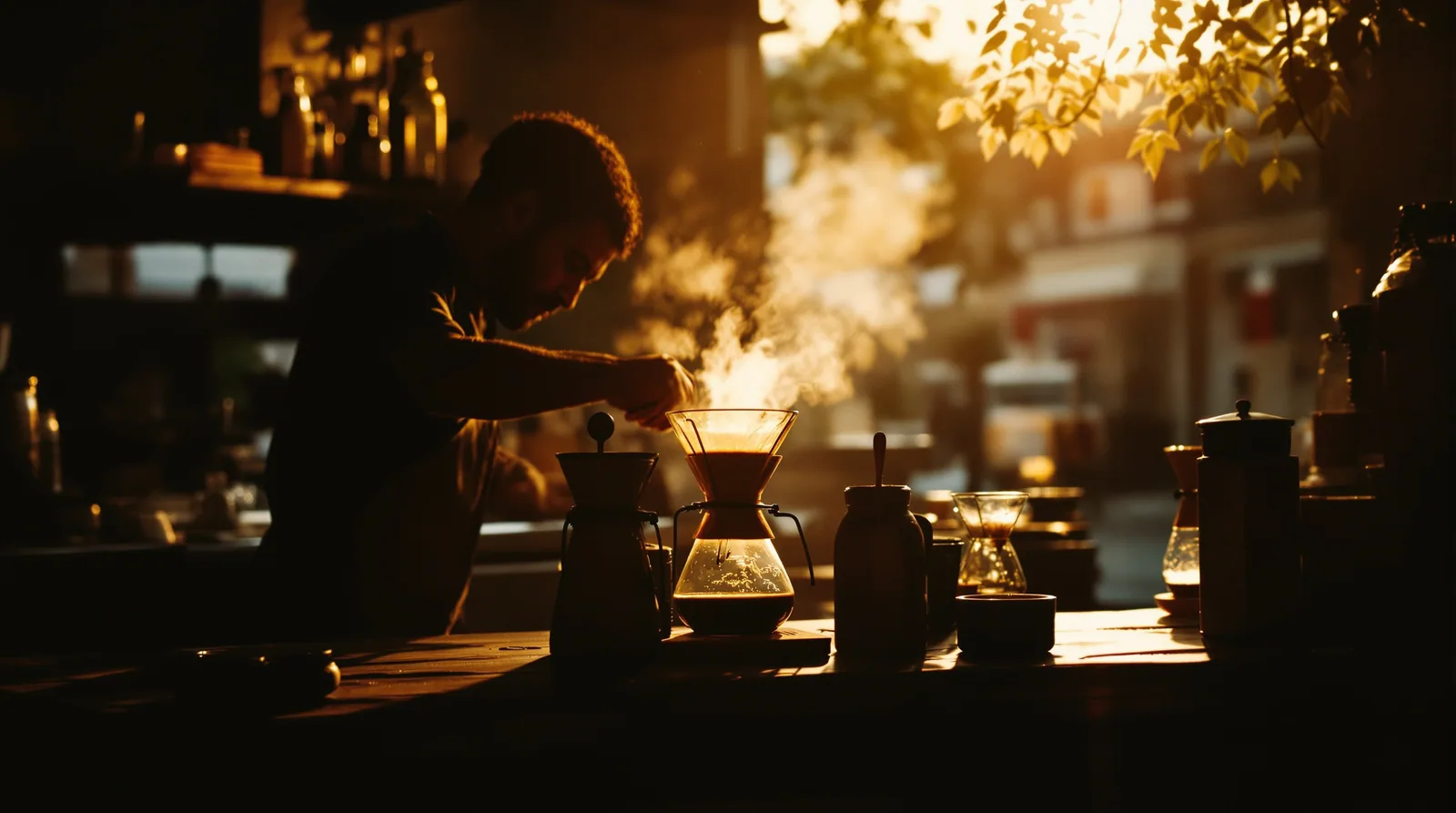
early morning light drenches a small cafe in addis ababa, where the air hums with the earthy aroma of freshly ground coffee. behind the counter, a barista deftly manipulates a chemex, guiding hot water over a bed of ethiopian heirloom coffee. it’s not your run-of-the-mill brew. the term "heirloom" captures something almost mystical, a spectrum of flavors and origins that seem to embody the soul of ethiopia itself. a splash of citrus, a hint of floral, each cup is a mystery waiting to be decoded.
the roots of heirloom coffee
ethiopia is where coffea arabica comes from. not as a myth or a marketing line, but as a biological fact: the wild forests of the southwest, places like kaffa and bench maji, are the genetic origin point for most of the coffee grown everywhere else on earth. that matters, because it means ethiopia didn't inherit coffee from somewhere else. it developed it, over centuries, across wildly varied microclimates, elevations, and soils.
the result is staggering biodiversity. according to wikipedia's overview of ethiopian coffee production, roughly 15 million ethiopians depend on coffee for their livelihood, and the crop accounts for around 30-35% of the country's foreign income. but the economic numbers only hint at something deeper. farmers in regions like sidama, harrar, and yirgacheffe have been growing coffee, often in natural forest gardens or on small family plots, for generations. trees that no agronomist has named. varieties that exist nowhere else. plants passed down the same way you'd pass down land.
the high altitude does a lot of the work here. much of ethiopia's specialty coffee grows above 1,800 metres. at that elevation, the cherries develop slowly, building complexity and sugar in a way that lower-grown coffees simply don't. when you taste a washed yirgacheffe and get that tea-bright clarity, that's altitude doing its thing.
---
decoding the term 'heirloom'
here is the thing: "heirloom" is not a precise botanical classification. it is a practical workaround.
as sprudge's liz clayton explains, the term emerged alongside the specialty coffee movement as buyers tried to categorise lots that contained multiple unknown varieties from the same farm or region. when you can't say "this is bourbon" or "this is typica," you need something to put on the bag. heirloom became that something.
agronomist getu bekele, co-author of a reference guide to ethiopian coffee varieties, frames it around two criteria: time and space. a true heirloom variety has been grown in a specific geographic area, by the same farming family or community, over several generations. that's the bar. it's not about age alone, and there's no official cutoff date.
what complicates things is scale. kea coffee puts the number of ethiopian varietals at over 10,000. most aren't named. many grow alongside each other on the same small plot, their cherries harvested and processed together. so "heirloom" on a bag might mean one unnamed variety, or it might mean forty. the farmer often can't tell you, and neither can the exporter.
the term is also starting to shift. as traceability improves and more genetic research gets done, named varieties are emerging from the heirloom category. varieties like 74110 and 74112, released from the jimma agricultural research centre, now appear on bags from specialty roasters who want to go deeper than a regional label. slowly, the fog is lifting. but for most of what gets exported, heirloom remains the honest answer to a question science hasn't fully answered yet.
---
profiles of flavour: what to expect
no single tasting note defines ethiopian heirloom coffee. that's the whole point. but there are patterns, and they mostly break down along two lines: region and processing method.
washed vs. natural
processing has an enormous effect on what ends up in your cup.
| processing method | typical flavour notes | body | common regions |
|---|---|---|---|
| washed (wet) | jasmine, bergamot, lemon, peach, green tea | light, tea-like | yirgacheffe, sidama |
| natural (dry) | blueberry, strawberry, wine, dark fruit, chocolate | full, syrupy | harrar, some guji |
| honey | stone fruit, caramel, mild florals | medium | less common, growing |
a washed yirgacheffe and a natural harrar can taste like they come from different planets. both are ethiopian heirloom. that contrast is exactly why the term frustrates people who want specificity, and exactly why it fascinates people who love variety.
regional signatures worth knowing
- yirgacheffe: the most exported. washed lots are famous for floral, citrus-forward brightness. jasmine and bergamot come up constantly.
- sidama (sidamo): often rounder and more stone-fruit-driven than yirgacheffe. good middle ground for drinkers who want complexity without edge.
- harrar: eastern ethiopia, dry-processed, and it shows. winey, blueberry-heavy, sometimes funky in the best way.
- guji: a sub-region that's been getting its own label more often recently. tropical fruit, sometimes a distinct floral depth.
- genika: from the bench maji zone. spice, wine, chocolate, and floral aroma. less common but worth hunting for.
the bloom on a v60 with a yirgacheffe natural is something specific: darker and more fragrant than most other origins, the grounds practically exhaling as the water hits them. once you've done it, you know what people mean when they say ethiopian coffee smells alive.
---
roasting heirloom coffee
roasting ethiopian heirloom requires restraint. most specialty roasters go light, and for good reason: too much heat for too long and you bulldoze the very thing you paid for. the florals go first. the citrus collapses. what's left is generic.
mtpak coffee's roaster guide notes that because heirloom lots contain multiple unknown varieties, roasters are often working without a precise density or moisture map for the entire bag. you're making educated decisions based on region and process rather than exact varietal data.
a few practical principles roasters apply:
- start with a lower charge temperature than you'd use for a central american washed coffee. ethiopian beans, especially naturals, can tip to roasty quickly.
- watch your development time ratio carefully. pushing development to coax sweetness can easily kill the high-end floral notes.
- rest the roast. natural-process heirlooms often need more degassing time before the flavour stabilises. some roasters wait up to two weeks before cupping their first evaluation batch.
- cup against the processing method, not just the origin. a natural guji needs different parameters than a washed sidama from the same shipper.
- accept variance between lots. two "ethiopian heirloom" bags from the same region, different harvest years, can behave differently on the drum. that's not a flaw. it's the nature of what you're working with.
one roaster at a small outfit in peckham described it to me as "roasting a conversation rather than a recipe." she meant that you're responding to what the bean is doing rather than following a fixed profile. it takes more attention. and the results, when it works, are worth it.
---
the marketplace and economic impact
ethiopia is africa's largest coffee producer and the world's fifth-largest exporter. coffee accounts for somewhere between 25-35% of the country's total export earnings, depending on the year, with millions of farmers feeding into a supply chain that ranges from forest gardens to major export cooperatives.
the heirloom designation sits interestingly in this market. on one hand, it has helped ethiopian coffee command premium prices in the specialty sector. buyers in tokyo, london, and melbourne pay more for a named ethiopian lot than for an unnamed commodity bag, and that price difference, when the supply chain is honest, can reach farmers. on the other hand, the vagueness of "heirloom" has historically allowed middlemen to bundle low-quality and high-quality lots together under the same label, obscuring value that should flow back to the grower.
the starbucks-ethiopia trademark dispute from 2006, where oxfam accused starbucks of blocking ethiopia's trademark applications for sidamo, harrar, and yirgacheffe, illustrated the stakes clearly. ethiopia argued that owning those names would let farmers negotiate better prices. starbucks eventually signed a licensing agreement. but the episode showed how much the naming and classification of ethiopian coffee is bound up in economics, not just botany.
the push toward traceability, naming specific cooperatives, washing stations, even individual farms, is slowly changing the market from the top down. when a bag says "kochere washing station, yirgacheffe" instead of just "ethiopian heirloom," it tells a more complete story. and a more complete story usually commands a fairer price.
---
daniel's story: a personal connection
daniel grew up in ethiopia and started roasting coffee alongside his mother before he could have named a single variety. the process was domestic, unhurried, and almost entirely tactile: raw green beans in a pan over heat, stirring constantly, reading colour and smell rather than any instrument.
when he started working in specialty coffee in the uk, the gap between that memory and what he found on the cupping table was disorienting. "people would ask me what variety i grew up with," he told me once, standing in front of a la marzocco at a roastery in bermondsey. "i had no idea. we just called it coffee. it was our coffee."
that's what the heirloom label captures, imperfectly but honestly. for daniel, the regional language made more sense than variety names. as mtpak coffee describes in their roaster's guide, ethiopian coffees are usually identified by growing region, jimma, yirgacheffe, sidama, rather than cultivar names like bourbon or typica, because that's how the farmers and communities themselves have always organised their knowledge of the crop. the land is the identity. the variety is secondary, often unknown, and in some ways beside the point.
daniel now roasts his own small lots under a label focused entirely on ethiopian origin. he still doesn't always know exactly what varietal is in a given bag. but he knows the washing station, the elevation, the farmer's cooperative. for him, that's enough. "heirloom is not a gap in knowledge," he said, scooping a handful of green beans and holding them to the light. "it's just a different kind of knowing."
---
faq
what exactly does 'heirloom' mean on an ethiopian coffee bag?
it means the lot contains one or more coffee varieties that haven't been formally identified or named. ethiopia has an estimated 10,000-plus distinct varietals, most of which have never been catalogued by geneticists. rather than leaving the variety field blank, producers and exporters use "heirloom" as an honest umbrella term. it's not a quality marker on its own, but it does signal that you're buying something with deep regional roots rather than a commercially bred cultivar.
is ethiopian heirloom coffee always high quality?
not automatically, no. the heirloom designation covers an enormous range of quality, from exceptional single-farm lots that score above 88 on the sca scale to bulk commodity coffee that shares the same label. what matters is the same as with any origin: the processing method, the washing station or farm, the elevation, and how carefully it was sorted and shipped. a specific lot from a named cooperative in yirgacheffe will tell you far more than the word "heirloom" alone.
why don't producers just name the varieties properly?
mostly because it's an enormous undertaking. genetic testing at the scale needed to catalogue thousands of distinct plants across a country the size of ethiopia requires significant funding and coordination. some work is happening, notably through the jimma agricultural research centre, which has released numbered varieties like 74110 and 74112. but progress is slow. in the meantime, regional and processing labels carry most of the descriptive weight.
how does processing method affect what an ethiopian heirloom tastes like?
dramatically. washed (wet-processed) ethiopian coffees, particularly from yirgacheffe, tend toward bright citrus, florals, and a clean tea-like quality. natural (dry-processed) coffees, common in harrar, develop intense berry and wine notes with a fuller, heavier body. the same heirloom plants, processed differently, produce cups that share almost nothing in common except their origin.
should i brew ethiopian heirloom differently from other coffees?
a pour-over method, v60, chemex, kalita, brings out the floral and citrus notes that make washed ethiopians worth seeking out. espresso can work beautifully with naturals, where the concentrated fruit sweetness balances the intensity. what most roasters agree on: don't over-extract. longer brew times or finer grinds than necessary will push these coffees into bitterness and flatten the complexity you paid for. brew a little lighter, a little faster, and let the coffee do its thing.
so, next time you're sipping on a cup of ethiopian heirloom, let the flavors unravel their story. it's more than just coffee; it's the essence of a land where every bean is a chapter in an ancient tale. embrace the mystery, for in each sip lies a world of unknown varietals and untold stories.